Independent courier opportunities: where the work comes from
Compare independent courier opportunities through marketplaces, firms and direct clients. Check UK setup and payment terms without an income promise.
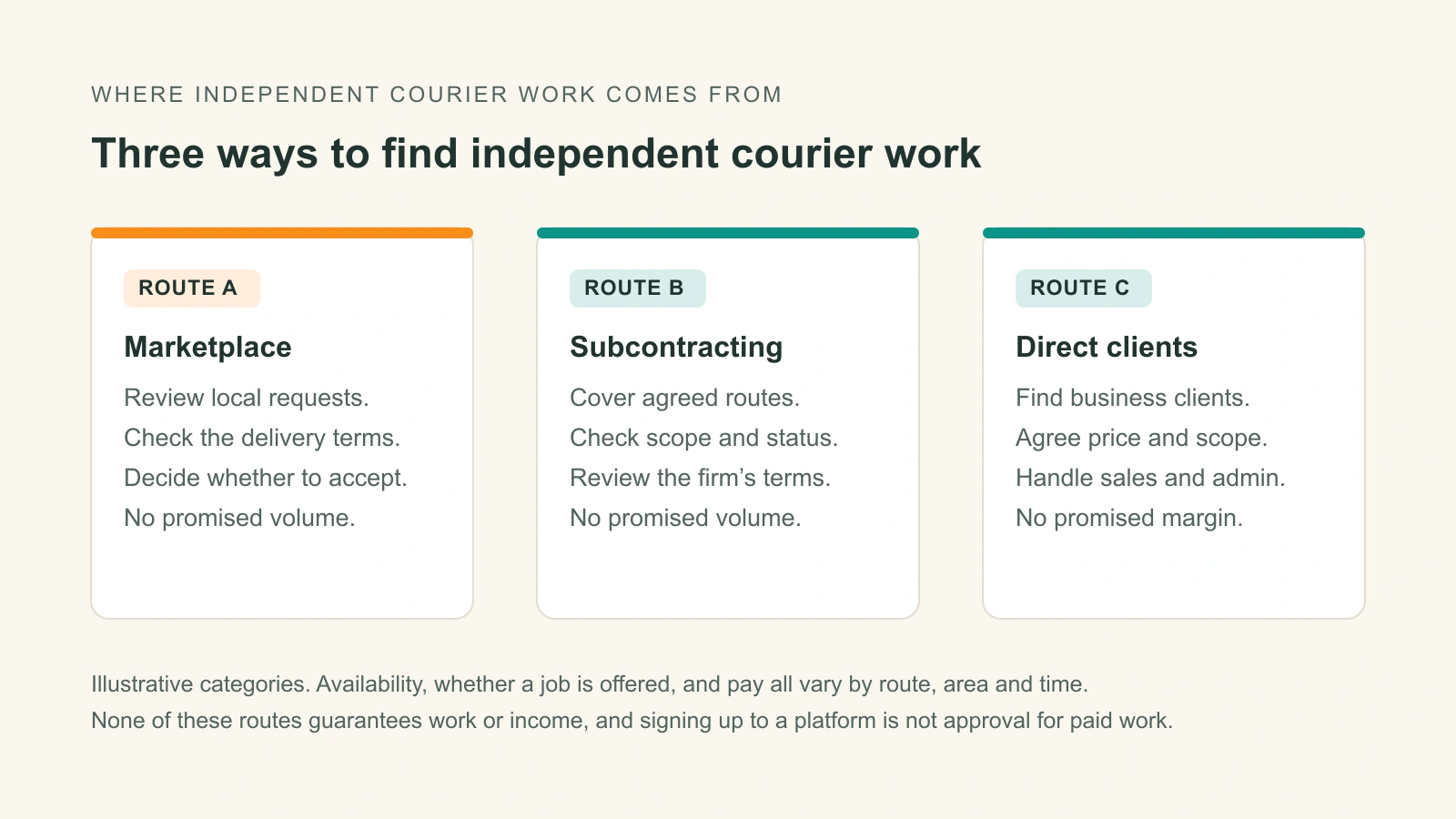
Independent courier opportunities can come from a marketplace, subcontracting to an established courier firm, or finding direct clients yourself. This guide compares those routes for someone considering self-employed work; it is not a vacancy list. Check the actual arrangement, responsibilities and payment terms before committing. An advert’s use of “independent” does not by itself establish your legal employment status.
That distinction matters before you chase any single advert. "Opportunity" here means a chance to be offered paid work, not a guaranteed wage. Understanding how the work reaches you, and what you have to put in place first, is the difference between a realistic plan and a disappointing week. If you already do this work and just want the right software, see our guide to independent courier apps.
- Check the arrangement. This guide focuses on self-employed work. Vehicle, insurance, tax and other responsibilities depend on the actual terms and applicable rules.
- Work is offered, not owed. A platform account, a subcontract or a client list is a chance to be offered jobs — not a guaranteed number of them.
- Check requirements before accepting. Permission to work, vehicle suitability, insurance, tax obligations and payment checks all need attention; not every requirement has the same deadline.
What does "independent courier" actually mean?
Here, independent courier means a person offering delivery services on a self-employed basis. But labels are not enough: GOV.UK explains that a contractor can have different employment statuses, and tax status may differ from status for employment rights. Check the actual relationship and seek qualified advice where uncertain; do not infer your rights from an advert’s title.
- Vehicle and running costs: check whether you supply an owned, hired or otherwise permitted vehicle, and who pays for fuel, maintenance and other costs.
- Insurance: confirm with the insurer that the policy covers the exact vehicle, paid delivery use and goods. Do not assume ordinary private cover is sufficient.
- Tax and records: establish what applies to your circumstances and keep appropriate income and expense records.
- Payment: compare the actual basis — for example a job, route, distance or agreed time period — together with deductions, cancellation terms and payment timing.
- Who finds the work: a marketplace, a firm you subcontract to, or you directly. More independence usually means more admin.
Where do independent courier opportunities come from?
The three routes in the diagram above suit different people. Many independent couriers use more than one at once — for example a marketplace for flexible local jobs and one or two direct clients for regular runs. Compare them on how the work reaches you and how much selling and admin you take on.
| Route | How the work reaches you | Trade-off |
|---|---|---|
| Marketplace platform | Eligible delivery requests may be offered through the platform; check the details and terms before deciding. | Account and delivery checks apply, and local requests or acceptance are not guaranteed. |
| Subcontract to a firm | An established courier company passes you routes or overflow as a contractor. | Steadier volume is possible, but on the firm’s terms, rates and schedule. |
| Direct local clients | You approach businesses yourself and agree rates, scope and invoicing. | More responsibility for finding clients and administration; a higher margin is not guaranteed. |
A word on adverts titled "independent courier jobs": many are job boards or a single firm’s recruitment page. Read past the headline to check whether the role is genuinely self-employed, what the vehicle and insurance requirements are, and how — and how reliably — you actually get paid. If you are weighing this against building a fuller operation, our guide on how to start a local delivery business covers the bigger commitment.
How does a marketplace like Routella Partners fit?
Routella Partners is a marketplace that connects local businesses with independent drivers. Routella is not your employer and does not promise you work. It is one way to be offered nearby delivery jobs: a business posts a delivery, you can see the approximate details, and you choose whether to accept, decline or — where the route allows it — counter with a different amount. Declining an offer is free.
Start with the actual country and area in which you intend to work, then review the requirements that apply there. The screen below is a current close-up of the public Partners driver signup form with the United Kingdom selected. It is not an available-jobs screen, an accepted route or proof that there is demand nearby. No application was submitted to make this image.
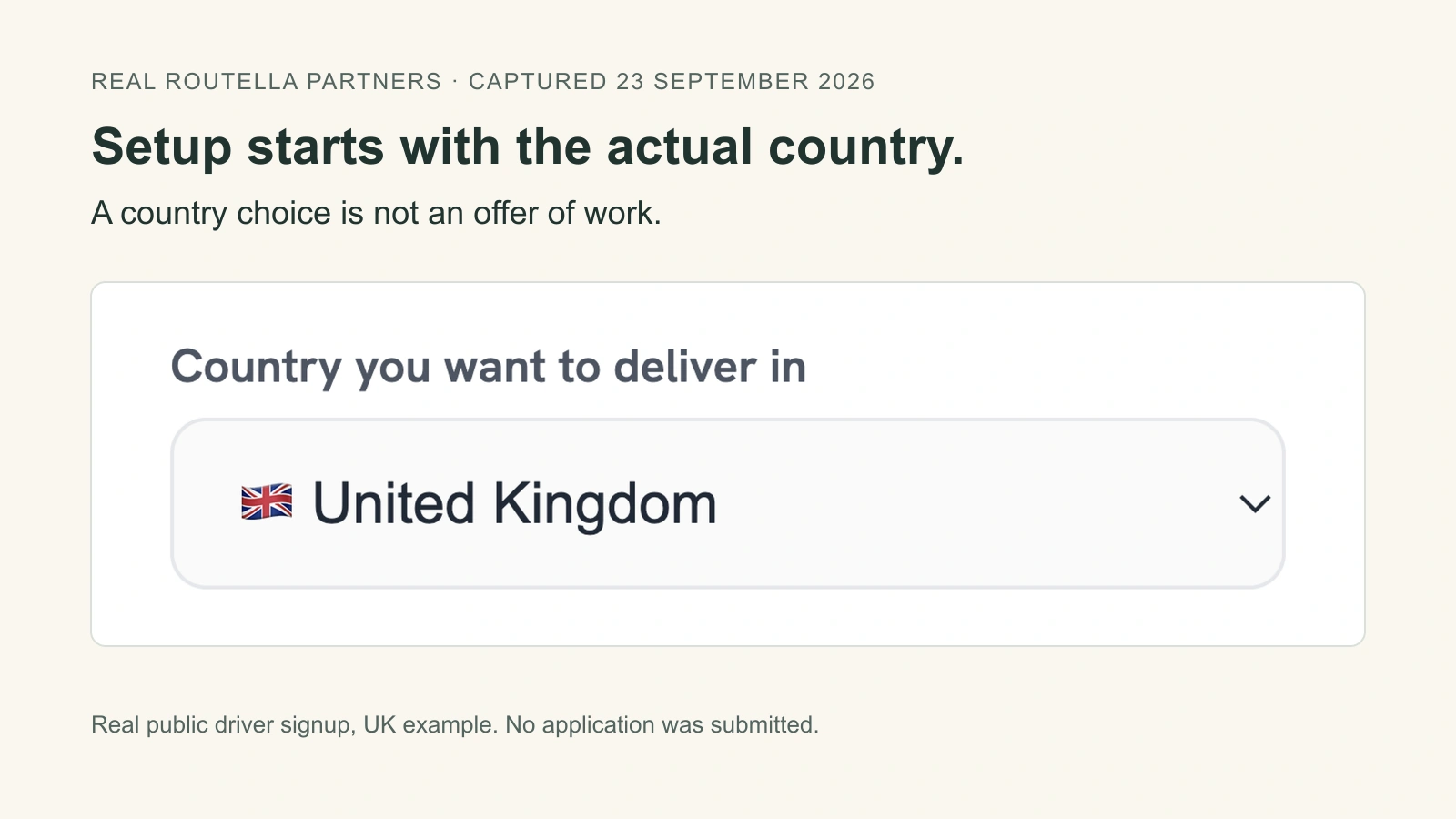
Public setup includes supported countries such as the United Kingdom. Being in a listed country does not by itself approve you or mean paid operations are open for your exact area: account, vehicle, service area, identity, payment, local rules and each delivery still need the applicable checks. Use the official secure setup for private account and payment information. Availability and opportunities vary.
What do you need before your first paid delivery?
Before accepting a job, resolve the requirements for doing that exact work lawfully and with suitable cover. Separately, check the recordkeeping, registration and reporting deadlines that apply to your situation. The checklist below is a United Kingdom starting point, not a universal list of things every driver must register for before their first delivery.
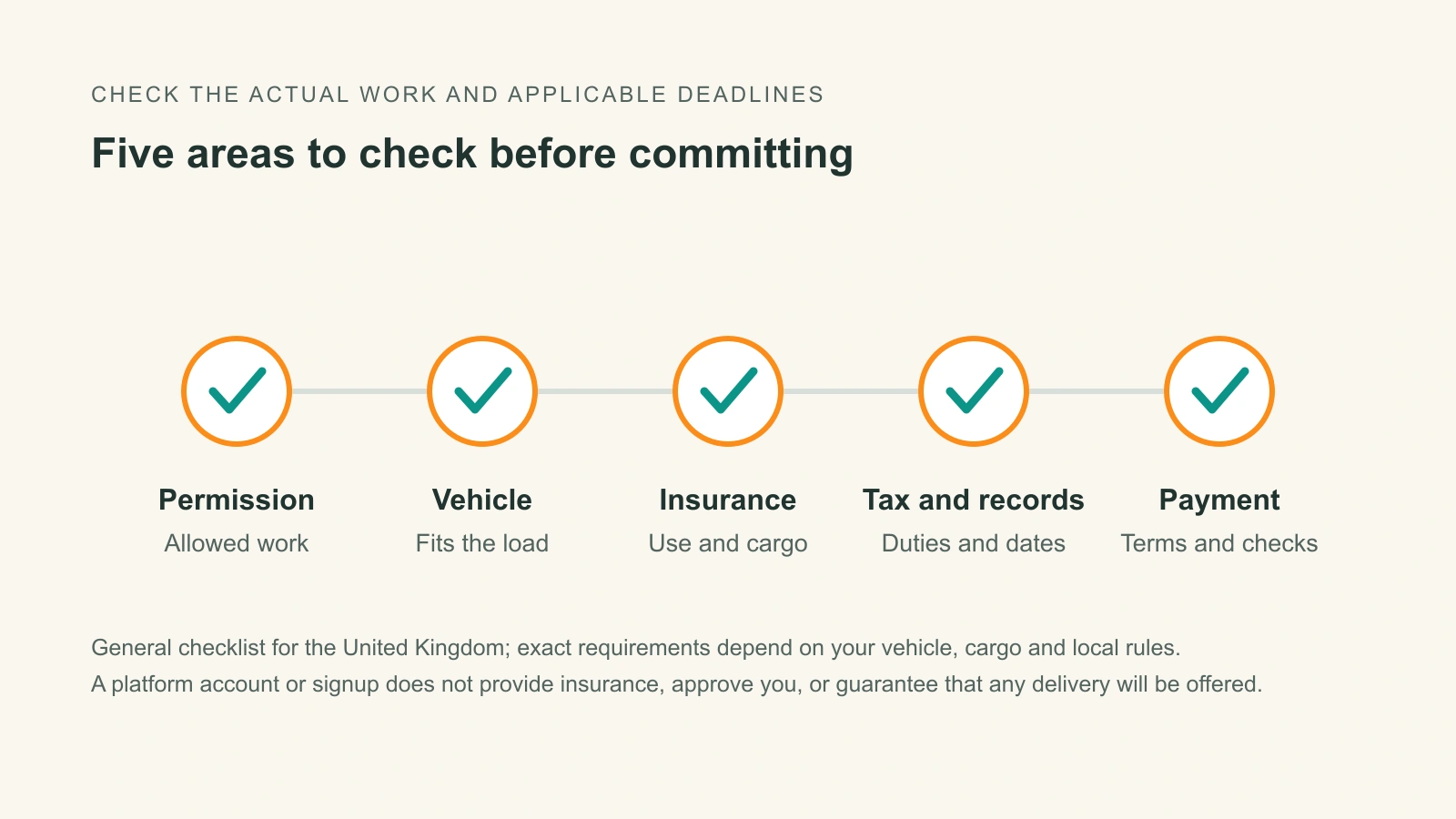
- Permission and status: confirm that the work is permitted and check the actual employment arrangement.
- A suitable vehicle: one that fits the loads you plan to carry and is legal and roadworthy for the job.
- Insurance: ask the insurer to confirm the required paid-delivery use and cargo cover, exclusions and limits for your exact work.
- Tax and records: keep appropriate records and check GOV.UK’s current sole-trader registration requirements and applicable deadlines. Registration is not universally due before a first delivery.
- Payment: confirm the payment method, required identity checks, deductions and when agreed work is paid.
How does the pay work, and what should you not assume?
Payment structures differ: a contract may price a delivery, a route, distance or an agreed time period. Check the exact scope, cancellation rules, deductions and payment timing. Compare the amount you expect to receive with the costs you bear, including necessary return travel, waiting and administration. Also allow for applicable tax. A headline rate is not take-home income.
- Do not assume steady volume. Offers depend on local demand, the time of day and your area; a quiet week is a real possibility.
- Do not assume the offer is the profit. The delivery amount is before your costs, not your earnings.
- Do not assume signup equals work. Being registered or accepted onto a platform is not the same as being offered deliveries.
- Do compare routes over time. Track earnings against miles and hours across a few weeks before deciding what actually pays.
Routella keeps this honest on its own platform: a driver can see approximate offers before accepting, decline for free, and use a private earnings estimate that subtracts the vehicle costs you enter — a planning tool, not a promise of take-home pay. None of it guarantees work.
The bottom line
Compare marketplaces, subcontracting and direct clients by their real terms, not a headline earnings claim. Resolve the vehicle, insurance, status and payment questions, keep the records you need, and check applicable registration deadlines. Treat an opportunity as a possibility of work rather than a guarantee. A careful comparison should tell you what remains uncertain as clearly as what is available.
Frequently asked questions
Is an independent courier an employee?
This guide focuses on self-employed work, but an advert’s label does not determine legal status. The actual arrangement matters, and UK tax status can differ from employment-rights status. Check the terms and current official guidance, and seek qualified advice if uncertain. Routella Partners is a marketplace, not the driver’s employer.
Where can I find independent courier opportunities?
Through three main routes: marketplace platforms that post local delivery jobs you can accept, subcontracting to an established courier firm that passes you routes, or finding direct local clients yourself. Many couriers combine them. In every route, availability and pay vary — an opportunity is a chance to be offered work, not a guaranteed amount of it.
Do I need special insurance to be a courier?
Do not assume ordinary private vehicle cover permits paid delivery. Ask your insurer to confirm the exact vehicle use, goods, policy limits and exclusions before accepting work, including whether separate cargo cover is needed. A platform account is not evidence that you have suitable insurance.
Does signing up to a courier marketplace guarantee me work?
No. Signing up to a marketplace such as Routella Partners lets you be offered nearby deliveries where they are available; it does not approve you automatically or guarantee any offers, an accepted delivery, or income. Your account, vehicle, service area and each exact delivery still have to pass identity, payment and local legal checks, and availability varies.
How much do independent couriers earn?
It varies and cannot be promised. Payment may be based on a delivery, route, distance or time, depending on the contract. Track what you actually receive against all the costs and hours involved, including waiting and necessary return travel, and account for applicable tax. A headline rate is not a guaranteed take-home amount.
Thinking about independent courier work?
Start independent driver setup in a supported country such as the United Kingdom. Account, vehicle, area and per-delivery checks still apply, and completing setup does not guarantee an offer, an accepted delivery, or any income.