Last mile delivery: a store-to-customer handoff guide
Understand last mile delivery and keep each handoff clear. A practical merchant guide to pickup readiness, tracking, delivery proof and failed attempts.
Last mile delivery is the final movement of goods from a local store, warehouse or distribution point to the recipient. It is a stage in the journey, not a literal one-mile distance. For a merchant, managing it means keeping the order, receiving instructions and handoff record connected until the agreed delivery is actually complete.
The difficult moments are often between the obvious status updates: an order is accepted but still uncollected, a vehicle has arrived but the entrance is wrong, or the parcels are at reception but nobody has agreed to receive them. This guide gives a small business a practical way to manage those gaps, whether it arranges a local driver in Jacksonville, Tampa or another eligible location.

What does the last mile include?
A first-mile movement gets goods into a distribution network. A middle-mile movement connects facilities. The last mile takes the order from its final local dispatch point to the customer or agreed collection location. Michelin’s guide describes that final stage and includes collection verification and delivery confirmation in the process.
A shop delivering directly from its own counter may not have a warehouse network at all. It still has a last-mile job. The term does not tell you how soon an order arrives, whether the driver makes other stops, or whether goods will be carried inside. Those are separate service details to agree.
This guide focuses on ordinary merchant handoffs, not a promise to handle every type of cargo. Heavy, fragile, controlled-temperature or restricted goods can require different vehicles, equipment, permissions and handling. Confirm the exact requirements before arranging the trip.
Keep five checkpoints clear from store to customer
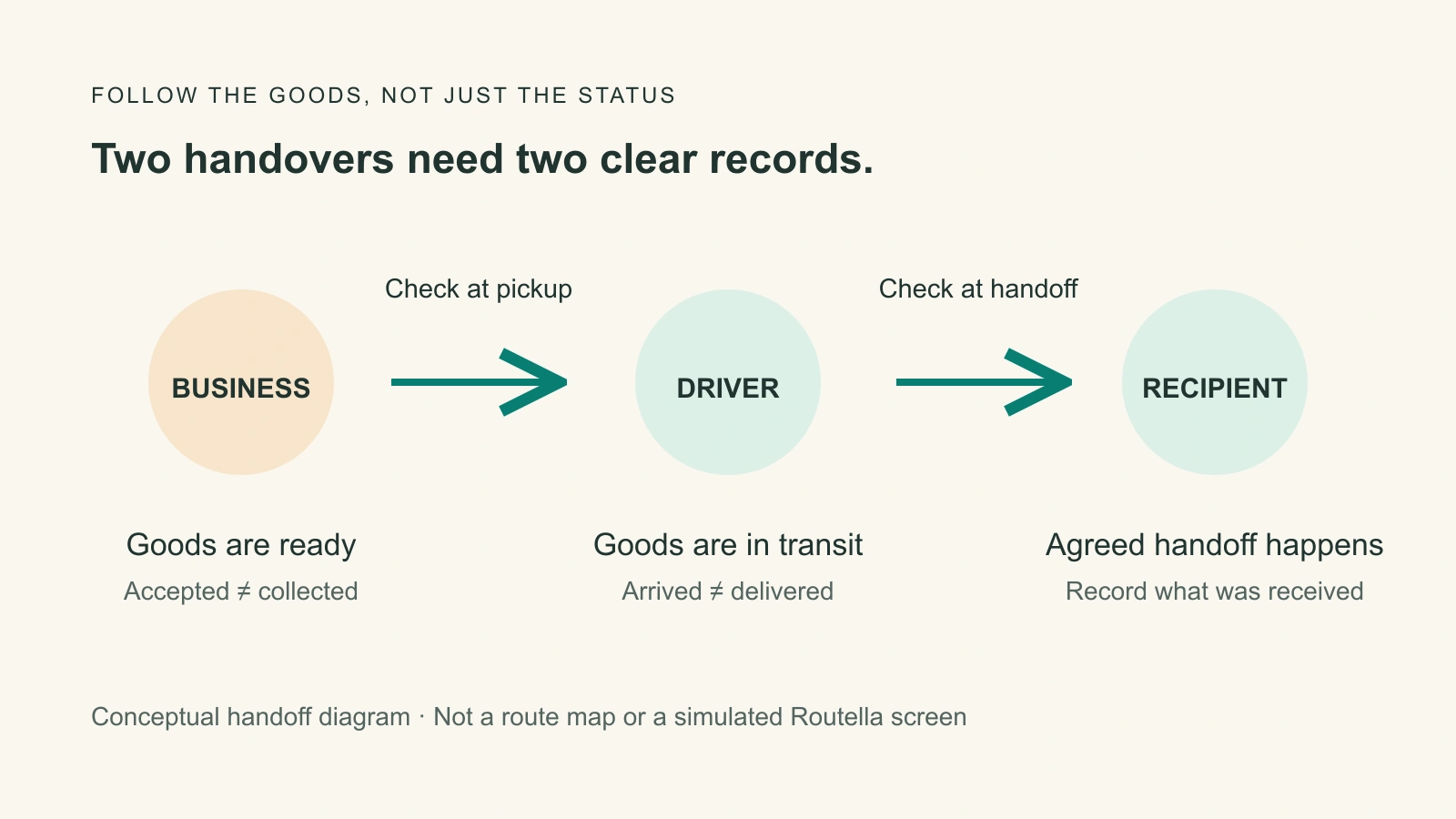
For each delivery, keep one shared operational record with a named person responsible for the next action. It can start as a simple checklist. The table below is a recommended working method, not a description of extra screens or automatic checks inside Routella.
| Checkpoint | Who acts next? | Record before moving on |
|---|---|---|
| Ready for pickup | The business | Packed quantity, actual ready time, correct entrance and loading arrangements. |
| Accepted, then collected | Business and accepted driver at pickup | Who accepted the job; then the separate package count and physical collection time. |
| Approaching the recipient | Driver; business handles customer exceptions | Useful current estimate and any access or receiving-window problem. |
| Received as agreed | Driver and authorized recipient | Right place, complete quantity and the supported proof agreed for this job. |
| Not completed | The named exception owner | Reason, location of the goods, contact attempts and the approved next action. |
At pickup, compare the actual load with the delivery request. If an order says two cartons and there is only one, resolve the difference while the goods are still at the shop. Do not rely on a later delivery photo to explain what was missing before the vehicle left.
At the destination, repeat the quantity and recipient check. “Arrived at the address” is not the same as “received by the agreed person.” A correct status should describe what actually happened, even if that means recording an unsuccessful attempt rather than closing the job.
Why distance alone does not explain the cost
A short drive can still involve unfinished packing, finding parking, carrying goods to the correct entrance and waiting for a recipient. A failed attempt adds another decision and sometimes another trip. Verizon Connect’s last-mile guide discusses how congestion, parking and changing windows complicate the final leg.
Separate travel time from service time at each end. If staff repeatedly spend fifteen minutes finding a packed order, the first improvement may be a marked collection area and a complete package list. If recipients are consistently unavailable, revisit the promised window. Faster routing cannot fix either problem by itself.
Review the full completed cost under the arrangement you actually use, including any agreed loading, waiting, returns and support work. Do not treat a percentage copied from an industry article as your business’s cost. A small run of your own records is a more useful starting point for deciding what to change.
Tracking answers “when”; proof answers “what happened”
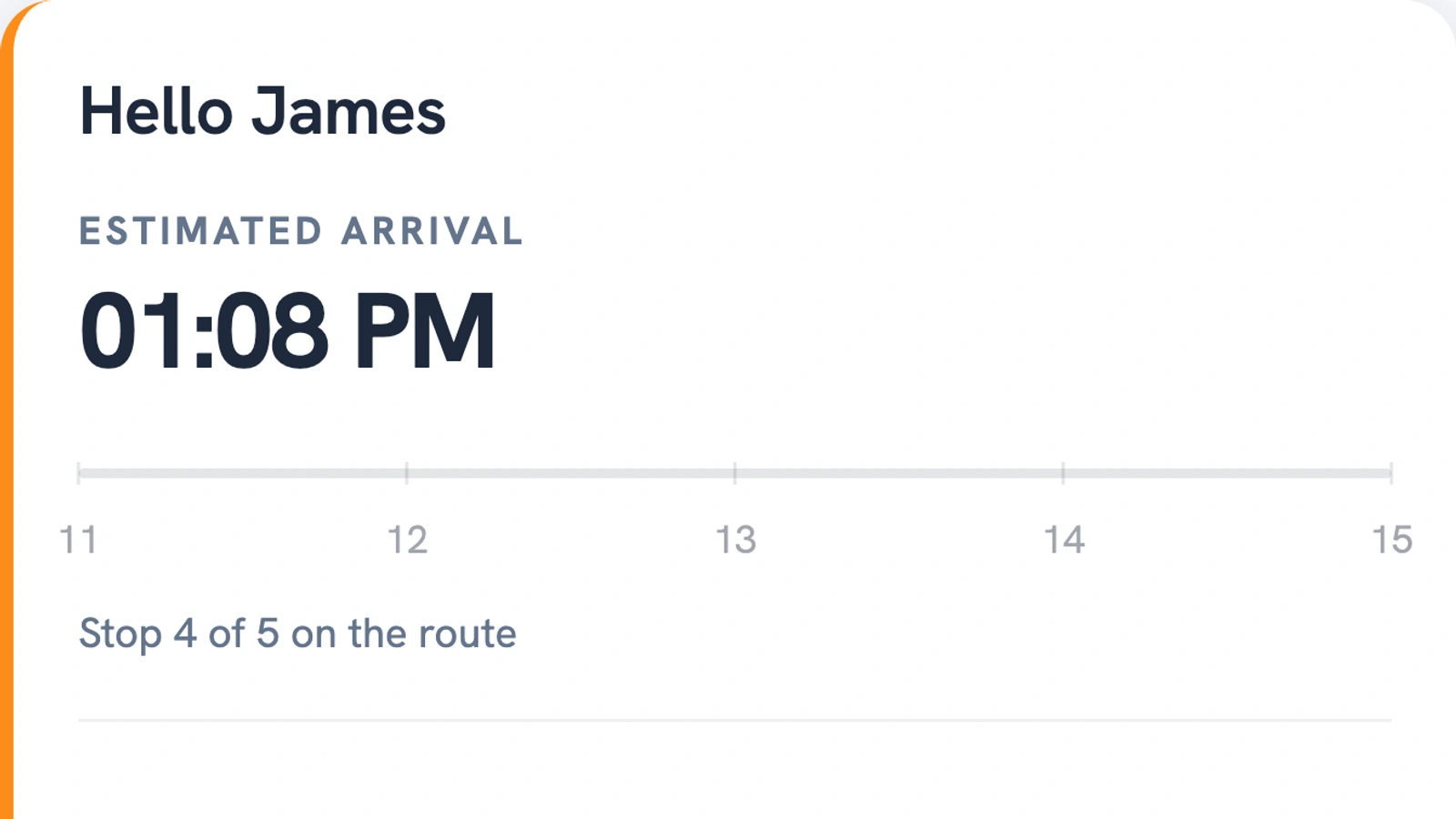
A useful tracking page can help the recipient plan for arrival and reduce the need to call the shop. It should be treated as current progress, not a receipt. A moving map, an estimated arrival or a driver at the correct address cannot establish that all the goods were handed over.
Agree the completion record beforehand. A photo may show the placement of goods, a signature may record an acknowledgment, and a supported scan may match an item or handoff. Each has limits. Our proof of delivery guide explains how to choose evidence without asking it to prove more than it can.
Work a failed-access problem all the way to the next decision
Consider a fictional homewares delivery: two cartons must be handed to a business reception before it closes. The driver reaches the street address, but the visitor entrance is locked. The goods are still with the driver. A vehicle-location update is useful here, but it does not resolve the handoff.
Do not leave parcels at a different doorway just to finish the stop, and do not tell a driver to wait indefinitely. Follow the agreed service, safety and exception rules. If a new entrance is confirmed, save the useful instruction for later orders only in the appropriate private customer or delivery record.
Bring the handoff plan into Routella Partners
Routella Partners connects businesses with independent drivers through a marketplace. Routella is not their employer. After completing eligible business setup, enter the exact pickup, stops, goods, timing and vehicle requirements. Use the supported pickup and drop-off checklists to make the expected actions clear, and select appropriate proof where the form offers it.
Keep readiness separate from collection. The business can mark all packages ready, while acceptance and the driver’s actual pickup are different events. Review the confirmation steps shown for your country, including any required named-seller choice. A saved request or an estimate does not mean a driver has accepted the work.
For Florida operations, check the exact pickup, destination and every stop against eligible incorporated-city boundaries. A Jacksonville or Tampa postal label alone is not enough. Each account and delivery still has to meet identity, goods, vehicle, payment and local requirements. Availability and acceptance are not guaranteed.
Improve the recurring gap, not just the headline number
Review a few ordinary deliveries using the same checkpoints. Which missing detail made someone stop and call? Which status did not match the goods’ real position? Fix the most repeated gap first, whether it is a ready-time estimate, package allocation, entrance instruction or unclear exception owner.
Once the records are consistent, use our last-mile delivery measurement guide to track trends. If the evidence points to a provider-fit problem rather than a handoff problem, our local delivery company guide covers that separate choice. The practical goal is simple: the right goods reach the agreed recipient, and everyone can find an honest record of the result.
Frequently asked questions
Is last mile delivery always one mile?
No. The term describes the final stage from a local dispatch point to the recipient, not a fixed distance. A local store-to-customer trip and the final leg from a distribution center can both be last-mile deliveries. Their timing, vehicle and handoff requirements may be very different.
What is the difference between last mile and same-day delivery?
Last mile identifies a stage of the goods’ journey. Same-day describes the intended arrival day. A last-mile delivery can be scheduled for another day, and a same-day delivery still needs an actual pickup plan, receiving window and accepted capacity. Neither term alone promises a direct or immediate trip.
Why can a short local delivery still be expensive?
The job includes more than driving distance. Packing delays, loading, parking, building access, recipient availability, proof and exception handling take time. Review your own completed costs and the terms for the exact delivery instead of assuming a short trip has a small total cost.
Does live tracking prove that the customer received the order?
No. Tracking shows progress and may show an estimated arrival or position. Completion needs the handoff and supported evidence agreed for that delivery. A vehicle at the right address does not by itself prove that the right person received every package.
Who should handle a failed last-mile delivery?
Agree a named contact and the exception rules before dispatch. The driver records the obstacle and where the goods remain; the appropriate business or provider contact decides the permitted next action. A return, later attempt, changed amount or refund must follow the actual service and approval process.
Bring a clear handoff plan to your next local delivery
Start Florida business setup in Routella Partners, then check the exact delivery and eligible driver options. Every account and operation must qualify; setup does not guarantee an accepted delivery.