Transport and courier companies: how a business chooses the right one
Transport and courier companies fall into three types. Learn which fits your delivery, what to send for a quote, and how a local courier marketplace works.
Most transport and courier companies fall into three types: a national parcel network, a same-day or dedicated courier, and a local courier marketplace. You choose well by matching the type to the order in front of you — its distance, urgency, size, proof and how often it repeats — before you compare names or prices.
A business searching for a courier is usually holding a specific job: a sealed parcel to post nationally, an urgent delivery across town this afternoon, or a weekly round of local drops. Those need different companies. This guide sorts the market into three honest categories, shows how to brief any of them for a useful quote, and explains where a marketplace such as Routella Partners fits. If you are still deciding between shipping, local delivery and collection, start with our delivery options comparison.
- Name the order first. Distance, urgency, size, proof and frequency decide the type of company you need.
- Check the service, not the brand. A national name can also sell a local same-day service, and a small firm can be the better fit for one job.
- A quote is not a booking. An account, estimate or open request is not a driver who has accepted the work.
What are the main types of transport and courier company?
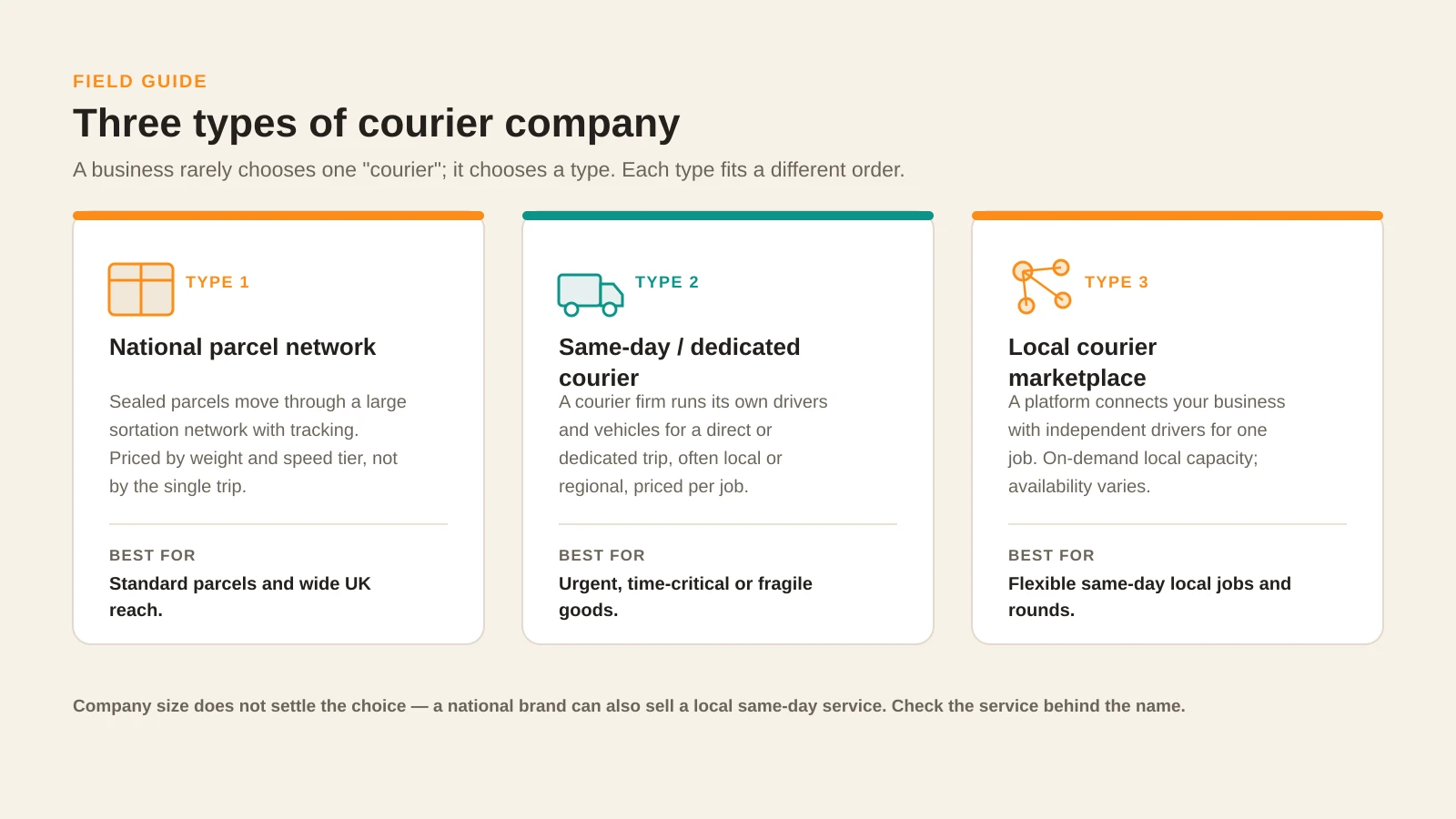
The market looks crowded, but nearly every provider sits in one of three groups. Many listing articles mix them together, which makes comparison harder. Separate them and the choice gets simpler.
| Type | How it works | Best for |
|---|---|---|
| National parcel network | Sealed, labelled parcels move through a large sortation network with tracking, priced by weight and speed tier. | Standard parcels going anywhere in the country, planned ahead. |
| Same-day or dedicated courier | A courier firm runs its own drivers and vehicles for a direct or dedicated trip, usually local or regional, priced per job. | Urgent, time-critical or carefully handled goods. |
| Local courier marketplace | A platform connects your business with independent drivers for one specific job; you set the offer and confirm the driver. | Flexible same-day local capacity for a single order or round. |
Brand size does not settle the choice. National carriers also sell local same-day services, and a local courier can be more reliable for a fragile, same-day job than a large network built for volume. Read the service description, not the logo.
Which type fits the delivery you need to send?
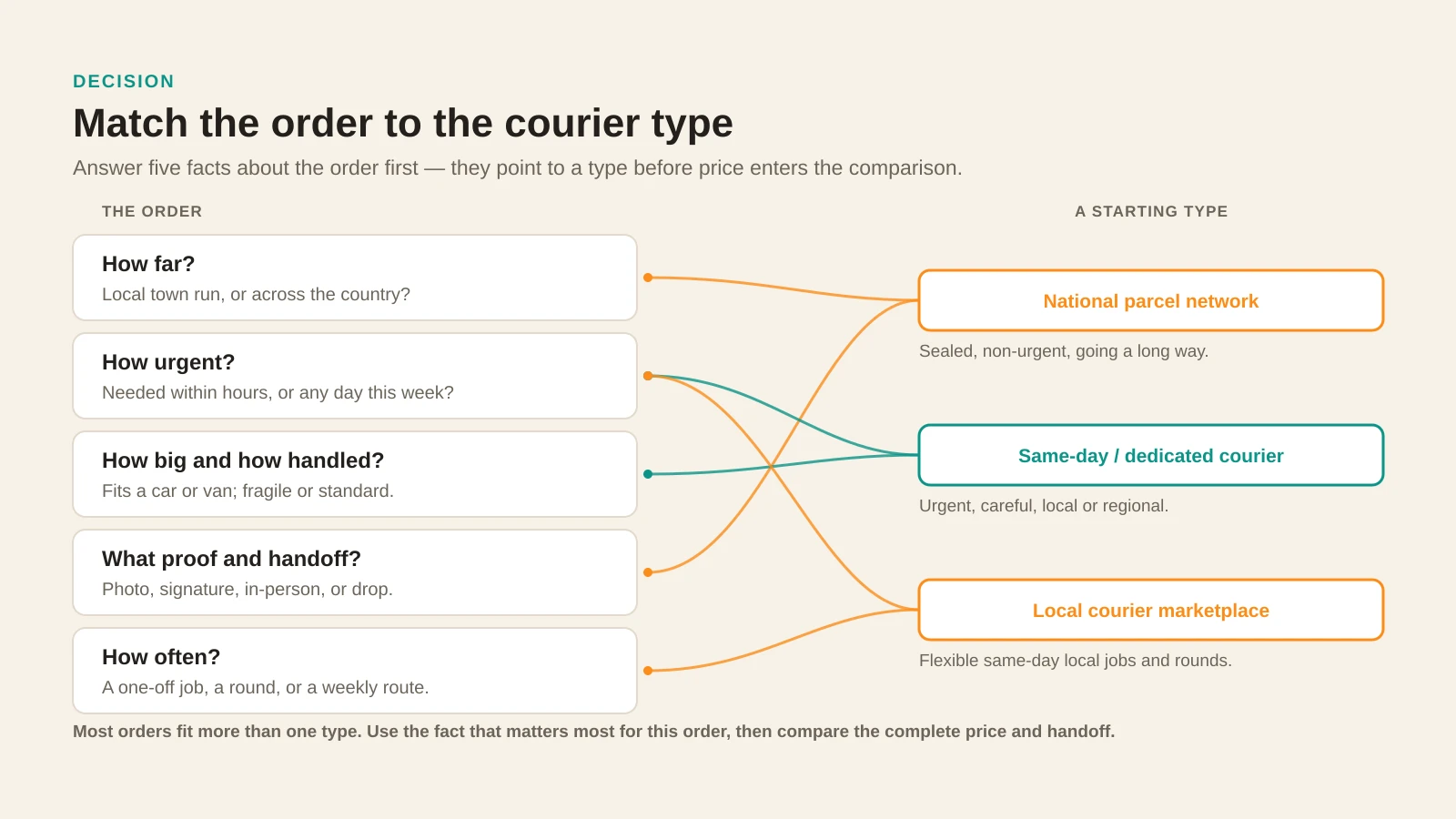
Start from the order, not the provider. Five facts about the delivery usually point you to a type before price enters the comparison. Answer them for the specific job, then shortlist companies inside that type.
- How far: a local town run and a cross-country parcel rarely suit the same company.
- How urgent: “within hours” points to a same-day courier or an on-demand driver; “any day this week” opens up a parcel network.
- How big and how handled: match the packed size, weight and fragility to a vehicle and a service that will carry it.
- What proof and handoff: decide whether completion needs a photo, a signature, an in-person handover or a safe-place drop.
- How often: a one-off job, a multi-stop round and a committed weekly route are different commercial arrangements.
Running your own drivers is a fourth path when you can keep a team busy and want tight control of the handoff, at the cost of vehicles, staffing and idle time between jobs. Our in-house versus outsourced delivery guide covers that larger decision.
What should you send to get a useful quote?
A request such as “a few boxes across town today” leaves any provider guessing about size, timing and handling, and the price that comes back is unreliable. Put the essential facts in one message so every company quotes the same job.
- Where: exact collection and delivery addresses, entrance, floor, parking and any stairs.
- What: contents, number of packages, packed dimensions, weight, value and any handling restrictions.
- When: the earliest the goods are ready and the latest acceptable arrival at each stop.
- Handoff: recipient contact, where the delivery may be left, and the photo, signature or code you need.
- If it fails: who to contact, whether a return is needed and who can approve the next step.
Those dimensions describe one hypothetical job, not a standard allowance. For several customers, list each address, package and deadline separately, and disclose fragile, chilled or restricted contents before comparing prices — a provider may need a specialist service or decline the work. For a fuller supplier review, use the courier service checklist.
What does the complete price include?
A starting price is not the total. Depending on the service, the final amount can reflect distance, stops, vehicle, load, urgency, waiting, tolls or a failed-delivery charge. Ask what is included and what can change it before you treat a headline figure as the cost.
| Cost item | Quote A | Quote B |
|---|---|---|
| Initial delivery amount | £14 | £23 |
| Waiting actually used | £9 | Included |
| Congestion or toll on the route | £5 | Included |
| Completed total | £28 | £23 |
Here the £14 starting price becomes £28, so the £23 inclusive quote is cheaper for this job. With no waiting or toll, the result could reverse — the point is to compare the same likely conditions, not two headline numbers. Check VAT and any excluded charges separately, and confirm what happens if the trip cannot be completed.
Staff time counts too. If someone spends half an hour chasing the driver, updating the customer and finding proof, record that beside the invoice. Over several jobs, compare cost per completed delivery, on-time arrivals and how often your team had to step in.
How does a local courier marketplace like Routella Partners work?
Routella Partners is a marketplace that connects local businesses with independent drivers. It is not a national parcel carrier, and Routella is not the driver’s or business’s employer. It is worth exploring when you need local same-day capacity for a single order, a round or scheduled work, rather than a labelled parcel travelling across the country.
After completing business setup, you use New delivery to enter the collection point, destination, goods, timing and required vehicle, and to set the proof and return requirements. You set the amount offered to the driver; Routella shows its marketplace fee separately. For a round, keep each stop’s goods and instructions apart so the driver knows what belongs where.
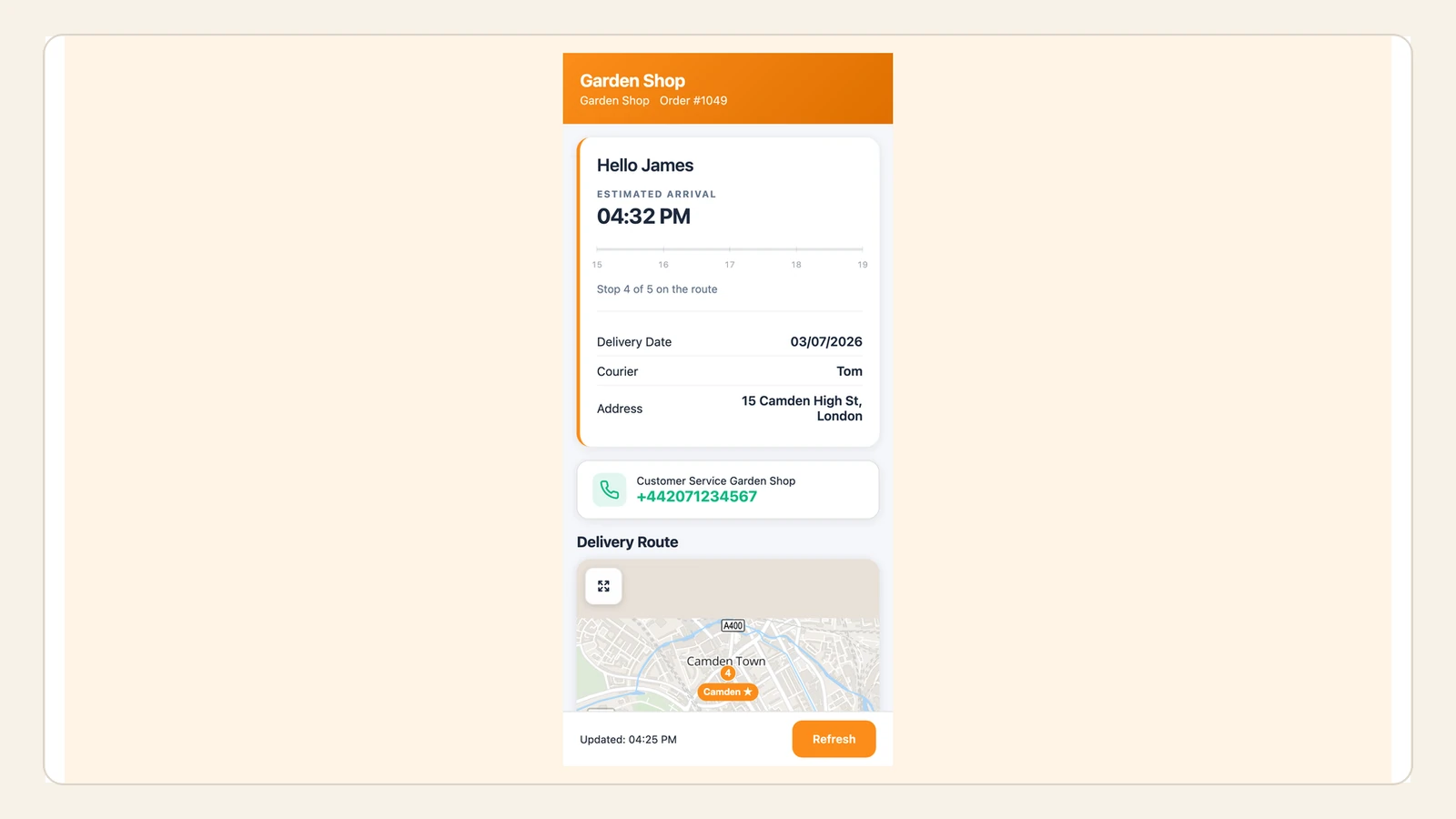
One practical difference from booking a single courier is what the customer sees. On a Partners delivery, the recipient can open a login-free tracking page with the live estimated arrival, their position in the route and the driver on a map, and automatic status messages are sent as the job progresses.
Access is available to eligible businesses in supported countries, including the United Kingdom. Being in a supported country does not by itself approve a job: the exact route, goods, vehicle, identity, payment and local legal checks still apply to each delivery, a saved draft or suggested amount does not book a driver, and driver availability varies. If you already employ the people who do your deliveries, Routella’s own-driver route-planning product serves that different need.
How do you test a new courier company safely?
Choose a suitable, ordinary order and a customer who understands the agreed window. One good trip is useful evidence but does not prove long-term reliability, so repeat the test across the kinds of work you expect before you widen your promise.
The bottom line
Do not shop for a “courier” in the abstract. Decide which of the three types fits the order, brief the shortlisted companies with the same clear request, and compare the complete price and handoff rather than the headline rate. When the job is local and same-day, a marketplace like a local delivery company or Routella Partners can add flexible capacity — as long as your account and each delivery qualify and a driver accepts the work.
Frequently asked questions
What is the difference between a courier company and a parcel carrier?
A national parcel carrier moves sealed, labelled packages through a large network on standard service levels, usually measured in days and priced by weight. A courier company typically runs a direct or dedicated trip — often local or regional — with the timing, vehicle and handoff agreed for that specific job. Many providers offer both, so confirm the exact service before booking.
How do I choose a courier company for my business?
Start with the order: its distance, urgency, size and handling, the proof you need and how often it repeats. Those facts point to a type — national parcel network, same-day or dedicated courier, or local courier marketplace. Then send the same detailed request to a shortlist inside that type and compare the complete price and handoff, not just the headline rate.
What is Routella Partners?
Routella Partners is a marketplace that connects local businesses with independent drivers for local deliveries. Public signup and paid marketplace access are available to eligible participants in supported countries, including the United Kingdom, but every delivery must still pass its route, goods, vehicle, identity, payment and local legal checks. Routella is not a national parcel carrier and not the merchant’s or driver’s employer, and driver availability is not guaranteed.
Can one business use more than one courier company?
Yes, and many do. A business might use a national parcel network for standard shipments, a same-day courier for urgent jobs, a local marketplace for flexible overflow, and its own driver for planned dense routes. Define a simple rule for each order pattern so staff are not choosing under pressure.
Have a local order that needs a driver?
Explore Routella Partners, complete business setup in a supported country, and prepare the delivery with the details from this guide. Your account and each delivery must qualify, and driver availability varies.