How much to charge for delivery: a store owner’s guide
Work out how much to charge for delivery with a cost example, a free-delivery threshold and checks for outsourced trips. Build your store policy.
To decide how much to charge for delivery, start with the complete cost of fulfilling the delivery, then decide how much of it your store can deliberately cover from the order’s margin. The customer pays the remainder. Check that the amount left on the whole order still meets your target, and that a suitable delivery option is actually available before promising a price and arrival window.
There is no single dollar fee that fits every shop. A planned nearby drop and a separate urgent trip can have different costs, even for the same basket. This guide is for merchants selling their own goods: it uses invented US-dollar examples to explain the decision, not to quote a Routella price, recommend a national rate or promise a profit.
Separate the three amounts
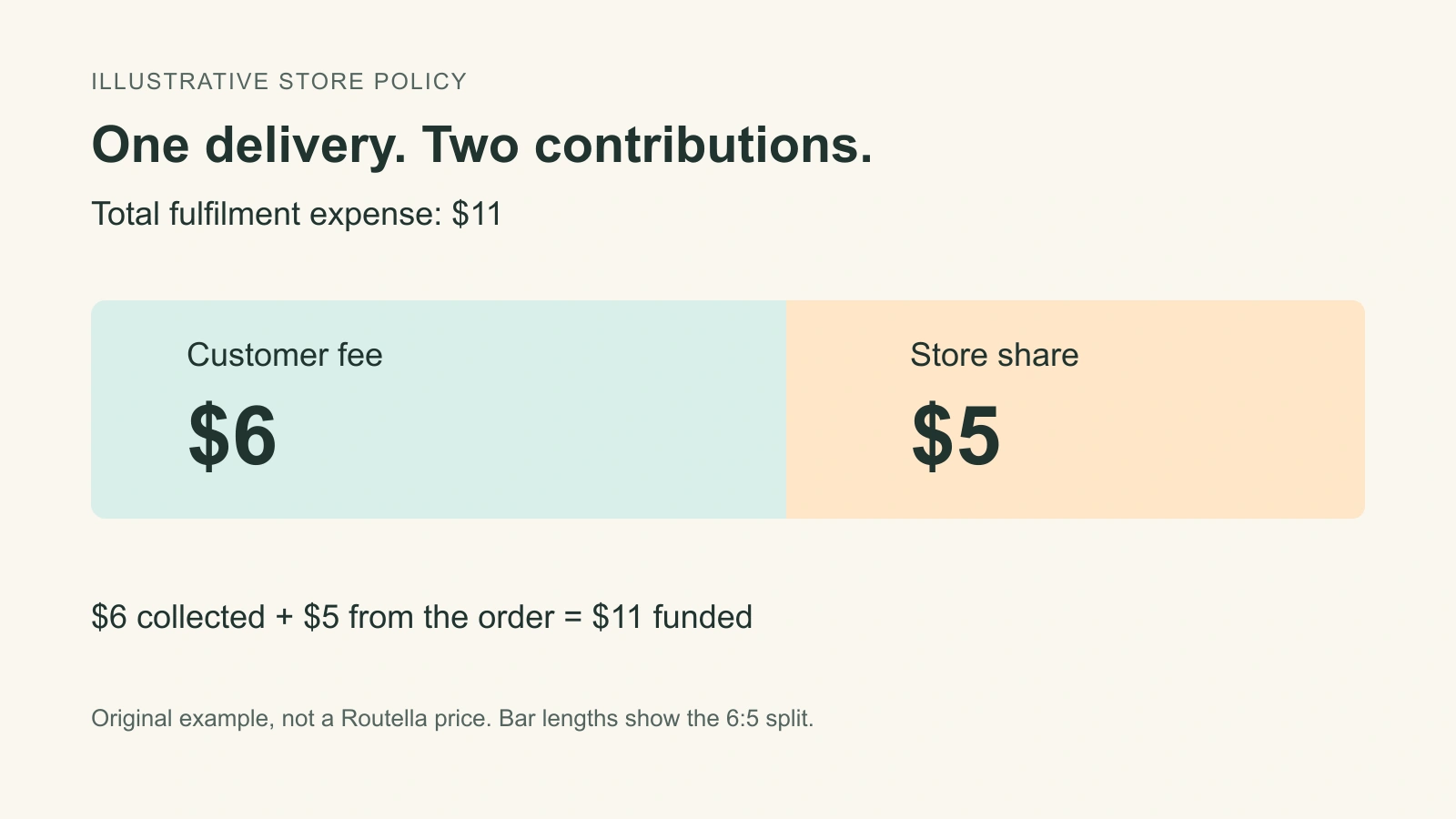
Keep three lines in your working notes. First is the customer delivery fee shown in your shop or checkout. Second is the merchant’s fulfilment expense: what it costs your business to get that order delivered. Third is the driver’s payout under the agreed arrangement. They may be related, but they are not interchangeable.
For example, an external provider’s charge may include more than the driver receives, and a shop can choose to absorb part of that charge. Do not label a store’s delivery fee as a driver tip or say it all goes to the driver unless that is actually how the arrangement works. Check the applicable breakdown and terms instead of guessing a commission percentage.
This distinction is particularly useful when comparing your own drivers with an outside delivery option. Our in-house versus outsourced delivery guide covers the operating choice. Here, the narrower question is what your customer should see and what your store is left with after fulfilment.
Start with a complete cost, then choose the customer fee
If you use an outside provider, start with the current price for the actual pickup, destination, timing, load and handling. Check what is included, what could change and who bears a failed attempt, waiting or return. Add your own delivery-only preparation costs and any applicable charges not already included. Do not add fuel or driver wages again if they are already part of that provider’s price.
With your own drivers, count the time and vehicle costs of the whole run, including necessary return travel and time at stops. Allocate shared costs consistently. Our delivery cost per drop guide explains that separate calculation. For either model, use a realistic completed-order cost rather than treating every attempt as a successful handoff.
- Record the scope: addresses, order size, service window, handling and any return requirement.
- Record the full expense: provider price or properly allocated own-fleet cost, plus delivery-only preparation and other amounts not already counted.
- Choose the store’s share: how much can this order contribute toward delivery while leaving enough for the business?
- Check the customer-facing rule: the fee, minimum order and service area must describe the same offer.
A competitor’s fee is useful context, not evidence of your costs or of what your customers will accept. The FreshBooks delivery-pricing guide highlights time, vehicle expense and extra services. Those inputs are useful checks; another company’s sample hourly or mileage rate is not your store’s price.
Work through a $50 order
Suppose a fictional store sells a $50 basket. After product costs and other order-linked expenses, but before delivery fulfilment, 30% remains: $15. Its complete delivery expense is $11, consisting of a $9 outside delivery charge and $2 of additional preparation. These are invented amounts on a consistent, tax-exclusive basis; they are not a provider quote.
| Line | With a $6 fee | With free delivery |
|---|---|---|
| Amount remaining from the goods: $50 × 30% | $15 | $15 |
| Customer delivery fee collected | + $6 | + $0 |
| Complete delivery expense | − $11 | − $11 |
| Amount retained | $10 | $4 |
If the store wants to retain $10 toward fixed overhead and profit, the $6 fee meets that example target. Making delivery free on the same order reduces the retained amount by $6. That might be an intentional promotion, but it is not a cost saving. Any additional payment-processing cost caused by collecting the fee also belongs in your real calculation.
Free delivery needs margin, not just a bigger basket
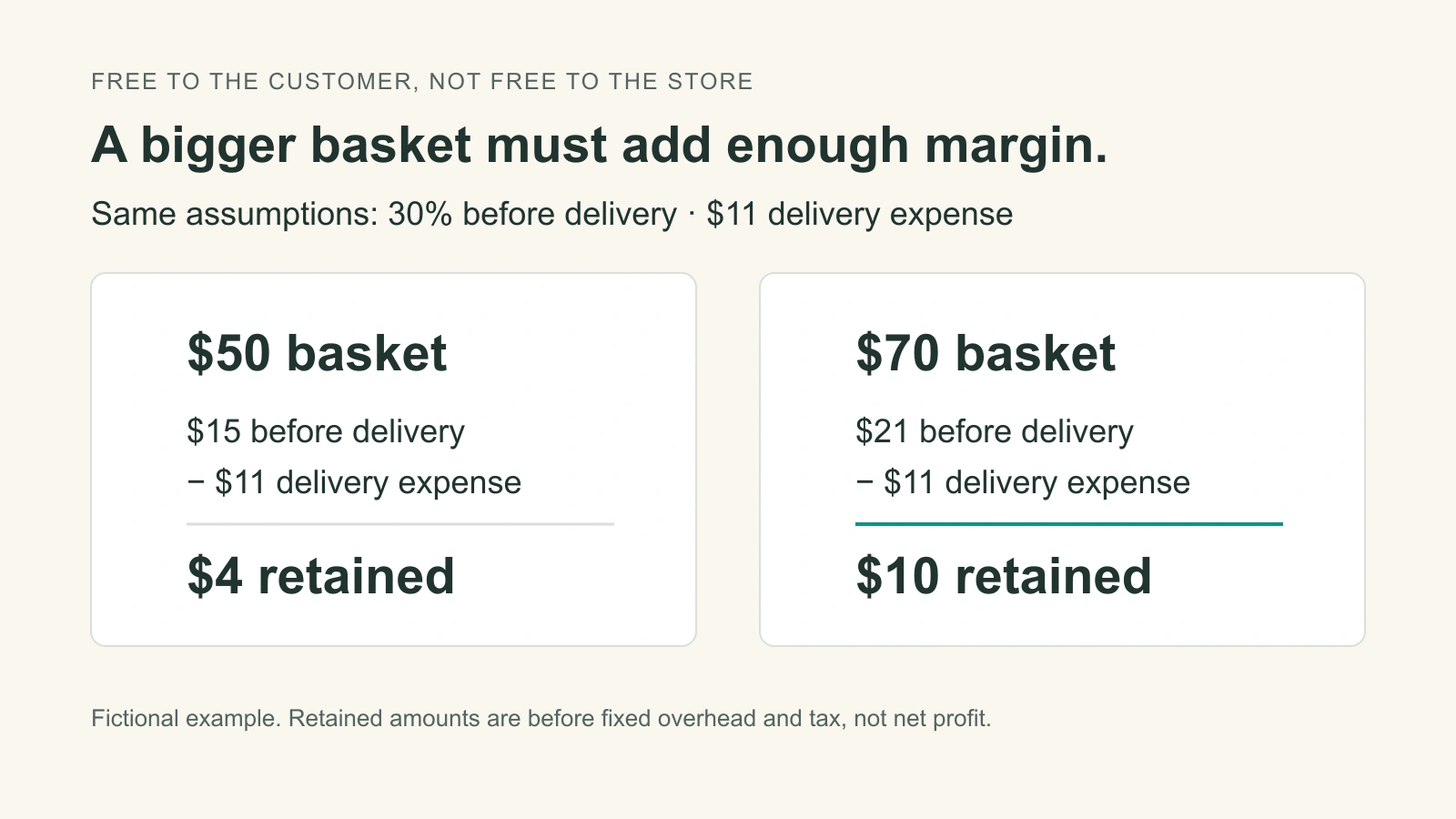
Under the same assumptions, a $70 basket leaves $21 before delivery: $70 × 30%. Subtract the $11 fulfilment expense and $10 remains, even with no customer delivery fee. The simple threshold calculation is (delivery expense + amount you want to retain) ÷ contribution rate. Here, ($11 + $10) ÷ 0.30 = $70.
Now change one assumption. If a discounted basket leaves only 20% before delivery, the threshold for the same $10 retained becomes $105: ($11 + $10) ÷ 0.20. A $70 basket at 20% leaves just $3 after delivery. A blanket free-delivery offer can therefore work on one mix of products and fail on another.
This is a simplified worksheet, not an accounting or tax rule. It assumes the delivery cost and contribution rate stay constant. Recalculate for discounts, different product margins, extra handling and changing quotes; if you cannot support those assumptions, use a more specific rule or a confirmed quote. A threshold also does not prove customers will buy more.
Choose a fee rule people can understand
Start with the fewest rules that accurately describe the service you can provide. A short, clearly bounded delivery area can suit a flat customer fee. Different zones may need different fees or minimum baskets. An unusual load or urgent separate trip may need a specific quote before confirmation. Do not extend a convenient flat price to work whose cost you have not checked.
Set the coverage limit as well as the fee. Our delivery zones guide explains the area decision. Tell customers the applicable charge, minimum, timing and important exclusions before they commit. If the request is outside the offer, present a supported alternative rather than silently treating the price as zero.
Check the fulfilment option before publishing your promise
Routella Partners connects local businesses with independent drivers through a marketplace. It is separate from Routella’s software for managing a business’s own drivers. For a merchant exploring outside delivery capacity, the important sequence is to check eligibility and the exact delivery arrangement before relying on a price or promising a customer window.
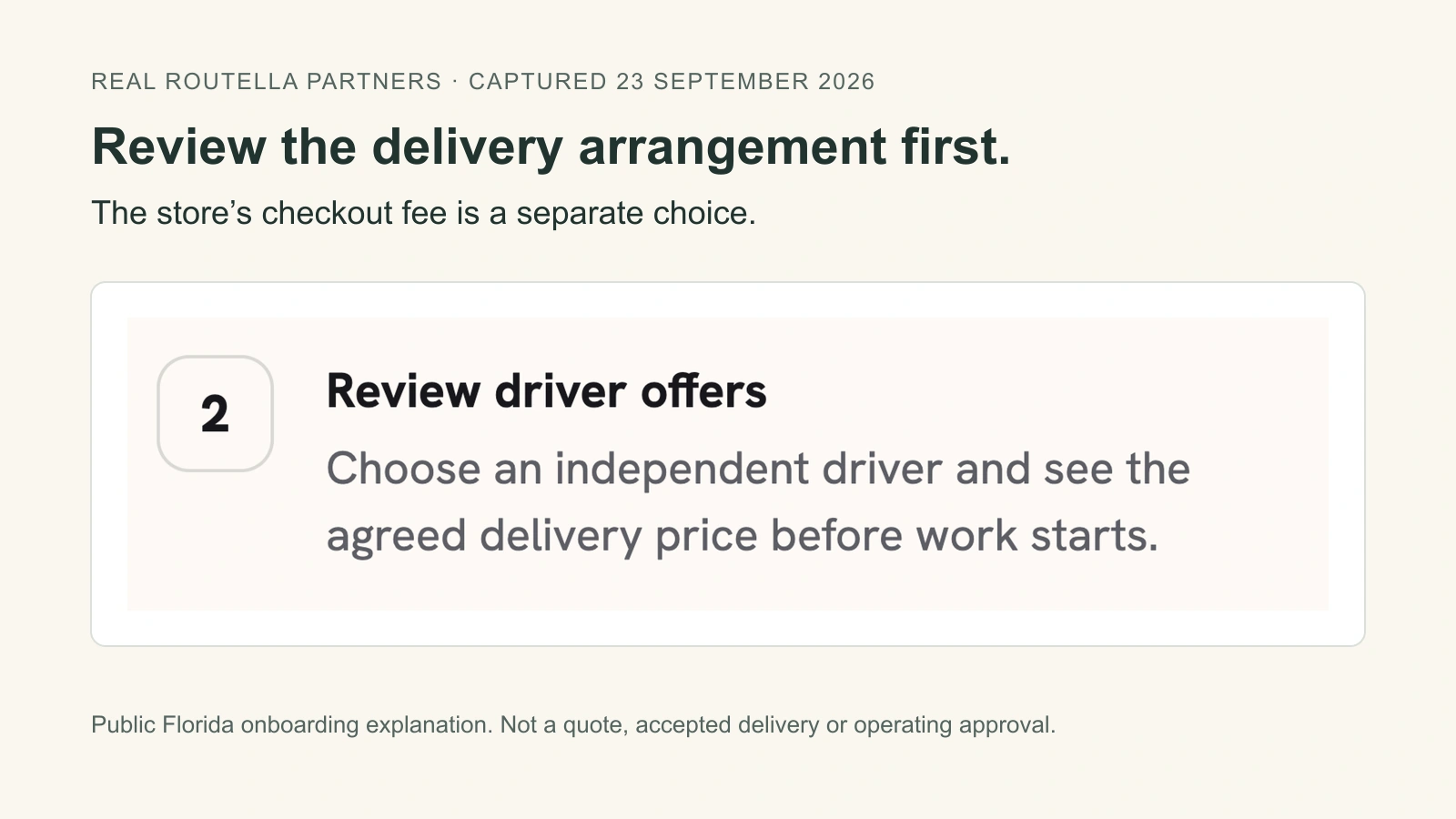
The real public merchant setup page below explains reviewing driver offers and the agreed delivery price. It is a close-up from the Florida onboarding explanation, captured September 23, 2026, not an actual quote or accepted delivery. In the Florida context checked that day, the request page still required paid operations approval. A signup path or supported-country list does not mean paid requests are open for every participant or area.
Routella is not the merchant’s or driver’s employer. Account, country and local area, exact addresses, goods, vehicle, identity, payment and other applicable checks still have to pass. Availability, driver acceptance, work and results are not guaranteed. The sample dollar amounts in this article are not Routella fees, and the marketplace is not being presented as a tool that automatically sets your shop’s checkout prices.
Test the edges, then review real orders
The shop system that displays the fee must apply the rule you intended. Shopify documents conditional local-delivery pricing and warns that overlapping eligible rules can produce the lowest applicable price. Wix documents several local-delivery rate types. These are those platforms’ controls, not a claim that Routella automatically configures them.
- At the minimum: check a basket just below, exactly at and just above the threshold, including after a discount.
- At the boundary: check an address inside the area, one outside it and one matching more than one rule.
- After a change: check how a changed basket, delivery scope or provider quote affects the confirmed customer price. Do not assume an extra cost can simply be added after purchase.
- When fulfilment is unavailable: make sure the customer is not offered a promise that the store cannot support.
- Before going live: use the store platform’s supported test or preview process, not a real charge or dispatch made only to test the policy.
After launch, compare the fee collected, actual delivery expense and amount retained on completed orders. Separate routine deliveries from urgent trips and failed attempts. If the rule is not working, review the fee, service area, minimum basket or delivery schedule before expanding it. The useful outcome is a policy your customer understands and your actual order economics support.
Frequently asked questions
Should a store charge the full cost of delivery?
It can, but it does not have to. A store may deliberately cover part of the expense from the order’s remaining margin. Check the whole order: amount left from the goods plus the customer fee minus complete delivery expense. What remains still needs to cover fixed overhead and tax before it becomes profit.
How much should I charge for delivery per mile?
There is no universal per-mile amount for a store. Distance alone can miss loading, waiting, returns and handling. If an external provider supplies the trip, use the complete applicable quote and avoid adding vehicle costs already included. A simple bounded customer fee may be easier to explain than copying the provider’s pricing formula.
How do I set a minimum order for free delivery?
Estimate the delivery expense and the amount you need to retain, then divide their sum by the share of basket value left after other order-linked expenses. Use a consistent basis. This simple calculation only works when those assumptions hold; discounts, product mix and higher delivery costs can change the threshold.
Is the customer delivery fee the same as the driver’s pay?
Not necessarily. The customer fee, the merchant’s delivery expense and the independent driver’s payout are separate amounts. Their relationship depends on the agreed service and applicable charges. Do not describe the customer fee as a tip or as money paid entirely to the driver without checking the actual arrangement.
Does Routella Partners set my customer delivery fees?
This guide does not present Partners as an automatic checkout-pricing tool. Partners is a marketplace for eligible businesses and independent drivers. Review the applicable delivery arrangement and checks separately from your store’s customer-facing fee policy. Setup does not guarantee operating approval, available capacity, driver acceptance or results.
Review the delivery option before setting your fee
Open Routella Partners to review the merchant path and applicable checks. Setup is not a quote, driver acceptance or a promise that paid delivery requests are open in your area.