Catering Delivery Software (2026): Timed Drop-Offs, Routes & Proof
How caterers deliver on time: planning backward from service time, timed drop-offs across events, driver routing, live tracking, and proof of delivery.
Catering delivery is not a "your order is on the way" business — it is a deadline business. The trays have to be on the table, set up and ready, before a meeting starts or guests sit down. A parcel that lands an hour late is an annoyance; a lunch that lands an hour late is a ruined event and a lost account. That single fact — a hard service time you plan backward from, not a loose window you aim at — is what makes catering delivery its own kind of routing problem, and why a general "shortest path" planner tends to let caterers down.
This guide is about running catering delivery well: how to turn a day of events into timed runs by working back from each service time, how to juggle several large orders that all want the same lunchtime slot, how to keep drivers efficient without gambling on a deadline, and how to prove every drop landed on time and complete. It sits alongside our guides to restaurants running their own delivery and same-day local delivery — this one is specifically about the off-premise, drop-off catering run.
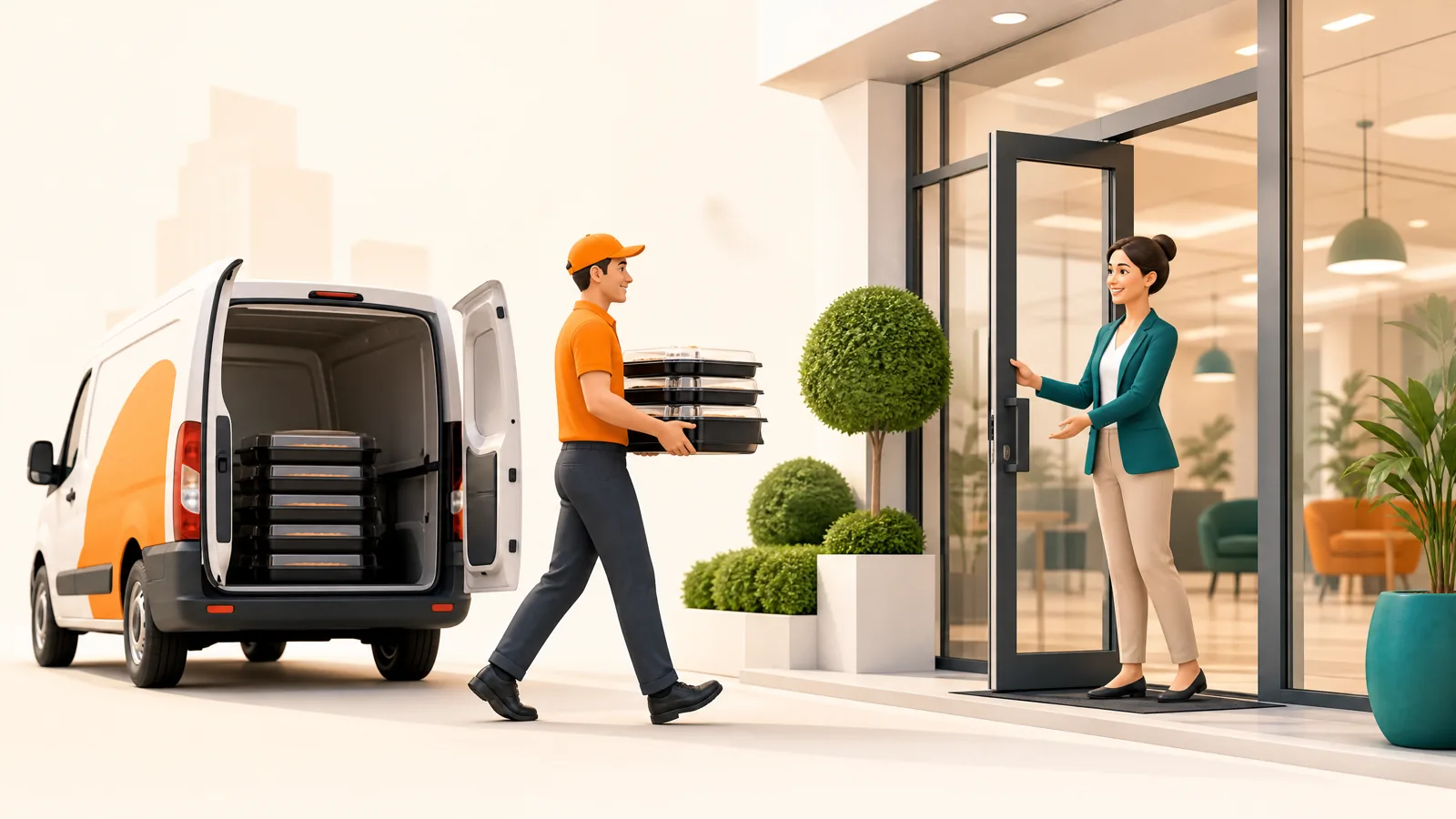
What makes catering delivery different?
A catering round looks like any other multi-stop route until you watch a real lunch rush. Five things set it apart, and a general route planner tends to miss all five.
- Hard deadlines, not soft windows. "Ready by 11:45 for a noon meeting" is a promise with no slack. The router has to treat the service time as a fixed constraint and sequence around it, not optimize purely for the shortest total distance.
- Everything wants the same slot. Corporate catering clusters hard around lunch — a dozen offices all want food set up between 11:30 and 12:30. The job is fitting many timed drop-offs into one narrow band across several drivers, which is a scheduling problem before it is a driving one.
- Setup is part of the stop. A catering drop is not a hand-off at the door — it is carrying trays in, laying out a buffet, sometimes waiting for a signature from an office manager. Each stop eats real minutes on site, and a plan that assumes a 60-second drop will run late by mid-morning.
- Big orders need the right vehicle. A full-tray order for eighty people does not fit in a compact car alongside three other events. Loads have to be matched to vans and sequenced so the last order out is still the first one needed — you cannot bury the noon delivery behind the 2pm one.
- One source of truth or chaos. Catering orders arrive by email, phone, a booking form, and a BEO (banquet event order) sheet. If they never land in one place with an address and a service time on each, dispatch is guesswork — and guesswork is how a tray ends up at the wrong building at the wrong hour.
Step one: put every event on one board, working back from service time
The root of most catering-delivery stress is orders scattered across an inbox, a phone pad, and a catering CRM. Before you can plan a single run, every event for the day needs to land in one place, each carrying its delivery address and — the field that matters most — its service time. Routella imports orders from 32 platforms plus a custom API, so if your bookings live in a catering or ordering system, the job is to get them onto a dispatch board where you can route and assign them, not to re-key them by hand.
Then turn each service time into a required arrival window. If lunch is served at noon, the food might need to be on site and set up by 11:45, which — after twenty minutes to carry in and lay out — means the driver arrives by 11:25, which — after a thirty-minute drive — means the van leaves by 10:55. Our guide to delivery time windows covers how to turn a promise-time into a routable constraint; in catering the trick is to bake the on-site setup minutes into the window, because the clock the client cares about is "ready to eat," not "van arrived."
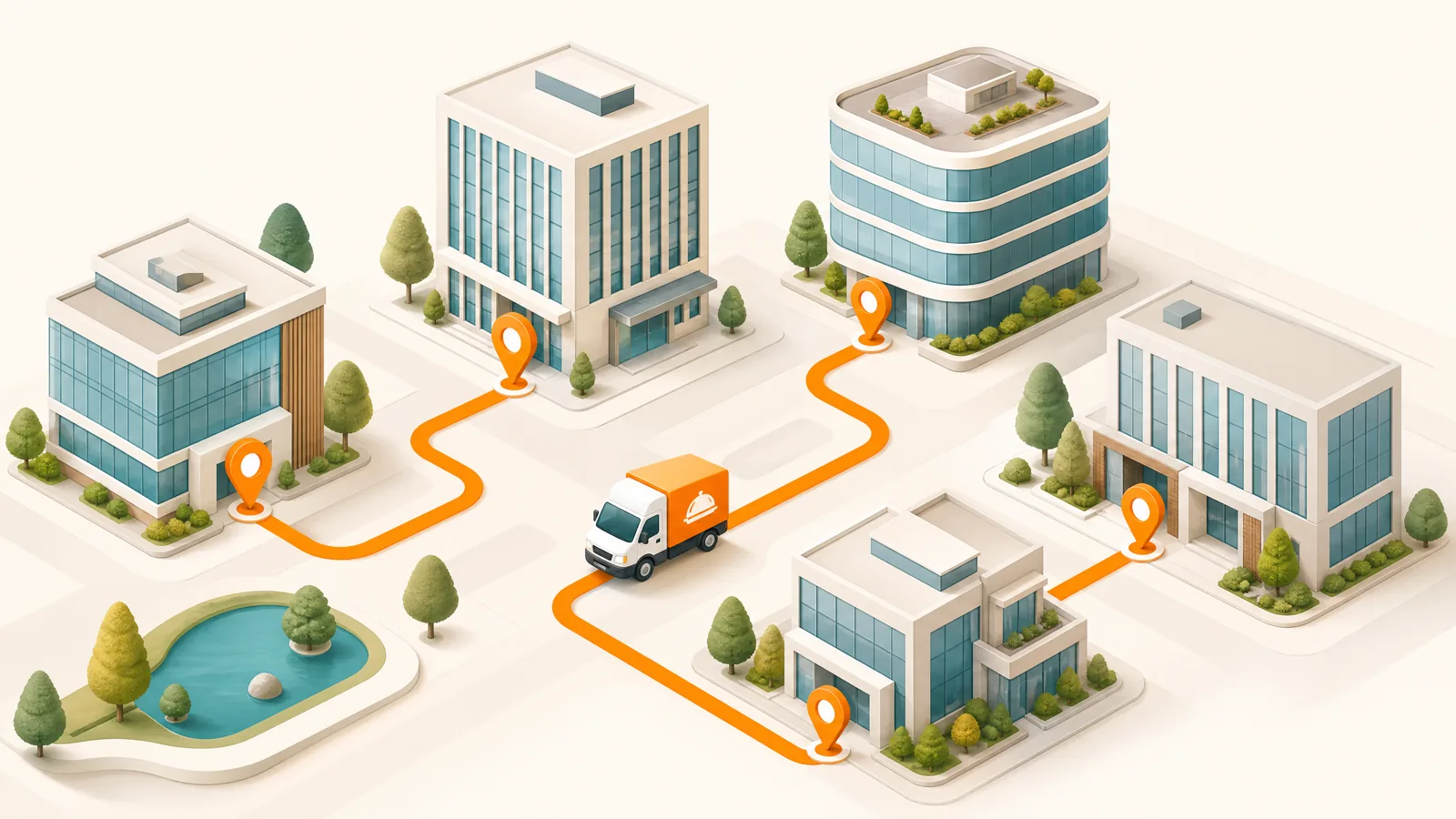
Step two: batch and optimize around the deadlines
With every event on the board and a real arrival window on each, group the drops that share a service band and a part of town into a run, then let the software sequence each run for the least driving that still hits every deadline. This is multi-stop route optimization with a hard twist: the fastest route is worthless if it reaches the noon event at 12:10. Time-aware optimization sequences so the earliest-due, tightest drops come first and the deadline is always respected.
Two habits keep a catering operation out of trouble here. First, plan by vehicle capacity: a lunch rush is bulky, and a route the map calls "optimal" is useless if the trays do not fit or the noon order is loaded behind the 2pm one. Sequence for time and distance, but cap each run at what the van holds and load it in reverse delivery order. Second, leave buffer on the tight ones — parking a van and carrying trays into an unfamiliar office takes longer than the map thinks, so a high-stakes noon drop deserves a departure that assumes the day goes slightly wrong. Routella’s Smart Routing add-on adds live-traffic-aware sequencing for a flat $5/month when you want the drive-time estimates to reflect real road conditions rather than a straight-line guess.
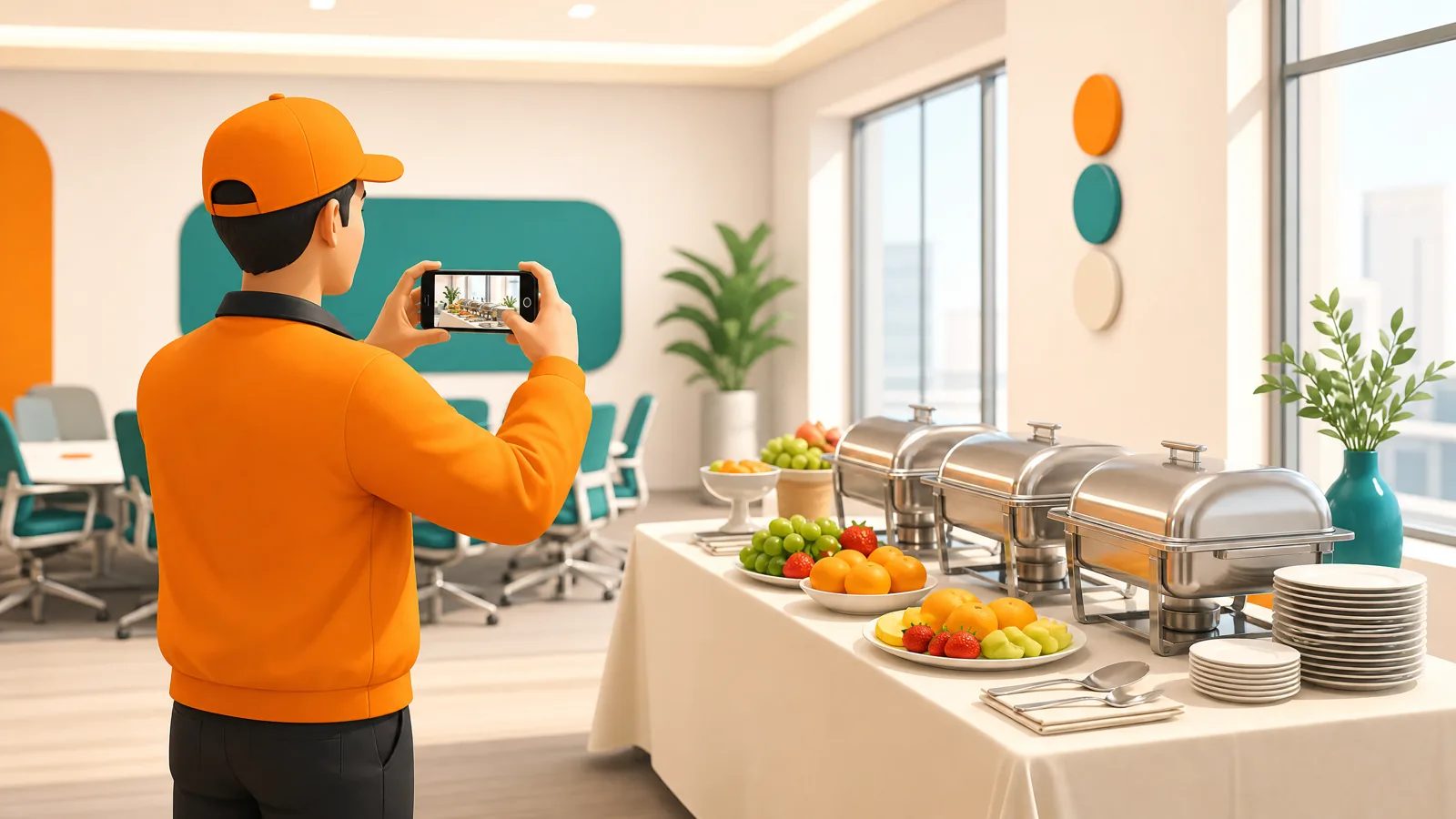
Step three: keep the client informed and prove the drop
A catering client is more anxious than an ordinary customer, because their own event is on the line — the office manager wants to know the food is coming before their meeting starts, not to be surprised. An automatic "your delivery is on the way" message with a live tracking link, sent when the driver starts the run, answers that anxiety without a phone call. Routella sends those updates by WhatsApp, SMS, or email and gives every order a live tracking page with a real ETA in 195 languages, so the client can glance at their phone instead of chasing your dispatcher.
Then prove it landed. Catering generates two disputes — "the food was late" and "half the order was missing" — and both are settled by capturing evidence at the drop. Routella’s proof of delivery attaches a timestamped, geotagged photo or signature to the exact order, so a photo of the set-up buffet at 11:47 answers a late-delivery complaint by pulling the record instead of arguing over it. For high-value corporate accounts, that timestamped proof is often what keeps the contract.
Do you need catering-specific software?
There are two layers to a catering delivery business, and it helps to be clear about which you are shopping for. The first is the catering layer — quotes, menus, BEOs, event management, and client CRM. Dedicated catering platforms own that layer and do it well. The second is the road layer — turning the day’s events into timed runs, routing drivers to hit each deadline, keeping clients informed, and proving the drop. That layer is last-mile delivery, and a focused delivery tool does it better than a bolt-on route feature inside a catering CRM.
Routella is the road layer. It takes your events in from whatever booking or catering system you already use, optimizes each timed run, gives drivers a mobile route that works offline, keeps clients informed with live tracking, and captures proof at the door — with a free plan and no credit card to start. If a route planner is all you need, run the free optimizer without connecting anything; if you want the notifications, tracking, and driver app, paid plans start at $29/month, and the $79 Pro plan includes WhatsApp messaging. For the wider picture, see how Routella works as an all-in-one delivery management platform.
A repeatable catering delivery workflow
- Consolidate. Pull every event for the day onto one board, each with its delivery address and service time.
- Work backward. Convert each service time into a required arrival window, baking in on-site setup, unloading, and drive time.
- Batch. Group drops that share a service band and a neighbourhood into runs, one per driver and vehicle.
- Optimize. Sequence each run for the least driving that still hits every deadline, capped at van capacity and loaded in reverse delivery order.
- Notify. Fire an "on the way" message with a tracking link when each driver starts, so the client knows the food is coming before their event.
- Prove. Capture a photo or signature of the completed setup at every drop, so an on-time, complete delivery is a record, not a claim.
Run that loop every day and the lunch rush stops being a gamble. The deadlines drive the sequence, the runs stay dense enough to pay, and the promise you make a corporate client — food ready before the meeting — is a promise the plan is built to keep. In a business where one late lunch loses an account, that reliability is the whole product.
Frequently asked questions
What is the best software for catering delivery?
It depends which layer you mean. A catering platform handles quotes, menus, BEOs, and client management; planning and tracking the delivery runs on the road is a separate job. For the road layer — optimizing timed runs around hard service deadlines, a mobile driver app, live client tracking, and proof of delivery — Routella is a strong all-in-one, imports orders from 32 platforms plus a custom API, and has a free plan with no credit card. It sits on top of whatever catering or ordering system you already use.
How do I plan a catering delivery route with fixed service times?
Work backward from each event’s service time. Subtract on-site setup, unloading, and drive time to find when the driver must arrive and depart, turn that into an arrival window on each stop, then group drops that share a service band and a neighbourhood into runs and optimize each for the least driving that still hits every deadline. Catering routing is a scheduling problem first and a distance problem second.
How do caterers deliver several orders on time during the lunch rush?
By batching and sequencing around deadlines, not distance. Corporate catering clusters into a narrow lunch band, so the job is fitting many timed drop-offs across several drivers and vans. Give each stop a required arrival time, cap each run at van capacity, load in reverse delivery order so the earliest-due order comes out first, and leave buffer on the tightest drops — a good router then sequences the run so every deadline is respected.
Does catering delivery software capture proof of delivery?
It should — catering generates "it was late" and "it was incomplete" disputes, and both are settled with evidence from the drop. Routella captures a timestamped, geotagged photo or signature at each stop and attaches it to the exact order, so a photo of the set-up buffet answers a complaint by pulling the record. For high-value corporate accounts, that proof is often what keeps the contract.
Can catering clients track their delivery?
Yes. With Routella every order gets a live tracking page with a real ETA, plus an automatic "on the way" message by WhatsApp, SMS, or email sent when the driver starts the run. That lets the office manager or event host see the food is coming before their meeting begins, instead of phoning your dispatcher to ask where it is.
Do I need catering-specific software or a delivery tool?
Often both, at different layers. A dedicated catering platform is best for quotes, menus, BEOs, and event management. For the delivery itself — routing timed runs, tracking drivers, notifying clients, and proving the drop — a focused last-mile tool like Routella does more than a route feature bolted onto a catering CRM, and it imports your events from the system you already use so you are not entering anything twice.
Run your own deliveries with Routella
Route optimization, a driver app, proof of delivery, and live customer tracking — in one platform. Free plan, no credit card.