How Many Deliveries Can One Driver Make in a Day? (2026)
How many deliveries can one driver do in a day? Realistic stops-per-day ranges by area, what sets the number, and how to fit more drops into the same shift.
It’s one of the first questions anyone planning deliveries asks: how many stops can one driver actually complete in a day? The answer decides how many drivers you need to hire, whether you can promise same-day, and — through your cost per drop — whether running your own fleet pays at all. The honest answer is “it depends,” but that’s not an excuse to shrug. It depends on a handful of factors you can measure, and once you understand them you can estimate your own number and, more importantly, raise it.
This guide gives realistic deliveries-per-day ranges for different kinds of routes, explains exactly what sets the figure, walks through a simple way to calculate your own, and covers the levers that let one driver complete more deliveries in the same shift — without driving faster or working longer.
- There is no single number. A dense urban courier and a rural furniture run live in different worlds — anything from ~8 to 40+ stops a day is normal depending on the route.
- Two things dominate: how far apart your stops are (drive time between them) and how long each stop takes (service time). Everything else is detail.
- Estimate it yourself: available road hours × 60 ÷ (service time + drive time per stop) gives a clean-day ceiling; real days run lower.
- You can add stops without adding hours — tighter zones, an optimized sequence, sensible time windows, and higher first-attempt success all buy you more deliveries from the same driver.
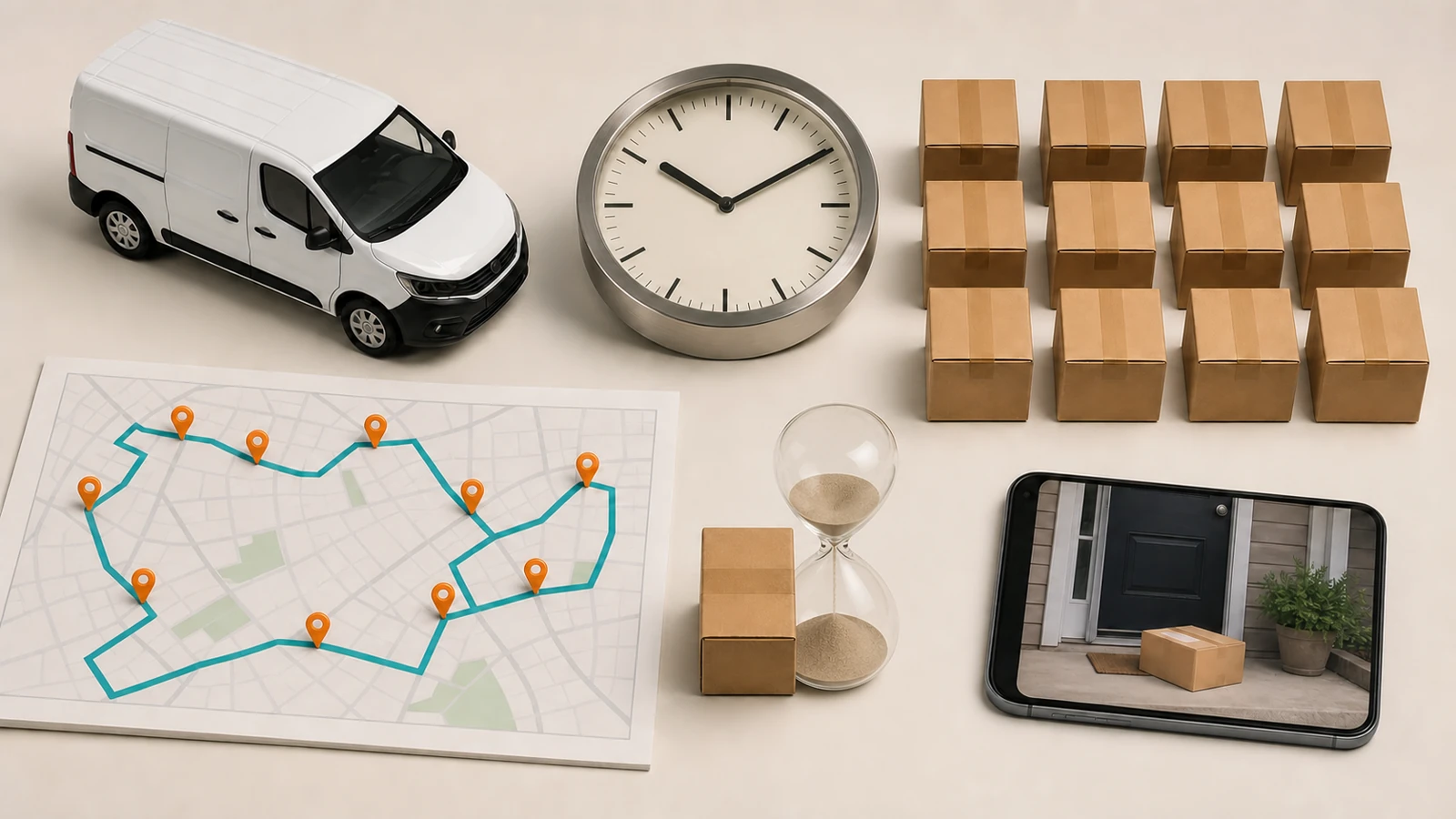
So, how many deliveries per day is normal?
For a business running its own drivers on local routes — the florist, restaurant, pharmacy, grocer, or online store delivering within a city or region — a working driver typically completes somewhere in these ranges over a shift:
One important caveat before you anchor on any of these: large parcel carriers are a different model. A contracted courier on a dense grid of tiny, pre-sorted packages can hit 80–120+ deliveries a day, because their stops are seconds apart and the handoff is a drop-and-go. That’s not the number to plan an in-house operation around. If you deliver flowers, medication, groceries, food, or furniture — where each stop involves a real handoff, sometimes a signature or a payment — you belong in the ranges above, not in parcel-carrier territory. Comparing yourself to a carrier’s stop count is the fastest way to set an impossible target.
What actually determines the number?
Strip it back and every route’s capacity comes down to how a driver spends the shift. Six things move the figure more than anything else.
1. Distance between stops (route density)
This is the single biggest factor. The closer your stops are, the less of the day a driver spends behind the wheel and the more of it they spend delivering. This is exactly what route density measures — stops per mile — and it’s why a driver working one tight cluster completes far more deliveries than one criss-crossing a whole metro. Density is set by geography, but you control it through how you draw zones and sequence stops.
2. Service time per stop
How long the driver is stationary at each door adds up fast. Industry benchmarks put a residential drop at roughly 2–4 minutes and a commercial delivery at 5–8 minutes, and anything that lengthens the handoff — a signature, a proof-of-delivery photo, cash to collect, a buzzer to find, an item to carry upstairs — pushes it higher. Multiply an extra two minutes per stop across 30 stops and you’ve lost an hour of delivering.
3. What you deliver
A pharmacy dropping small bags moves faster per stop than a two-person crew carrying a sofa up three flights. Parcel size, whether the item needs assembly or placement, and whether an appointment window applies all change both service time and how many stops fit in a day. This is why per-vertical numbers differ so much — a courier and a furniture delivery aren’t comparable.
4. Time windows and appointments
Promising “between 2 and 4 PM” protects your success rate but constrains the route — a day full of tight windows forces a driver into backtracks that eat stop capacity. Used well, windows actually help; used carelessly, they’re a hidden tax on deliveries per day. We cover the balance in using delivery time windows without wrecking your routes.
5. First-attempt success
A failed delivery doesn’t just cost you a redelivery later — it steals capacity from today’s route, because the driver spent the miles and minutes to reach a door and completed nothing. Every not-home or wrong-address stop is a delivery that didn’t count. Lifting first-attempt rate is one of the quiet ways to raise your effective deliveries per day; the same moves that reduce failed deliveries apply here.
6. Driver experience and working hours
A driver who knows the area, the buildings, and the parking spots is measurably faster than a new hire, and a full 8-hour shift obviously fits more than a 4-hour one. These are real, but they’re the smallest levers — you can’t out-experience a route that’s badly clustered.
How to estimate your own deliveries per day
You don’t have to guess. A simple back-of-envelope formula gets you close using numbers you can measure from a normal route:
Work an example. Say a suburban driver has about 7 productive road hours after loading and breaks (420 minutes), spends around 4 minutes at each door, and averages 6 minutes of driving between stops. That’s 420 ÷ (4 + 6) = 42 stops as a clean-day ceiling. In reality you’ll land lower — a failed attempt here, a return-to-depot there, a stretch of traffic — which is why the realistic suburban band sits nearer 15–25. That gap between the ceiling and the real figure is precisely the room that better planning reclaims.
The most useful thing about the formula isn’t the number it spits out — it’s what it shows you can change. You can’t easily add road hours, but you can cut the drive time between stops and trim the avoidable minutes at each door. Both directly raise the figure.
How to fit more deliveries into the same day
Here’s the encouraging part: most operations are leaving deliveries on the table, and the fixes cost nothing in extra vehicles or headcount. In order of impact:
Why the “average” number can mislead you
Be careful planning your whole operation around a single deliveries-per-day figure. A blended average across a good route and a thin one hides the money-losing route inside a healthy-looking total — and a driver’s capacity on paper isn’t their capacity on a badly clustered day. The number to trust is your own, measured per route and tracked over time. Deliveries per driver per day sits naturally alongside on-time rate and first-attempt rate in your last-mile delivery KPIs; if it’s drifting down on the same delivery area, your cost per drop is quietly drifting up.
Turn the number into a plan
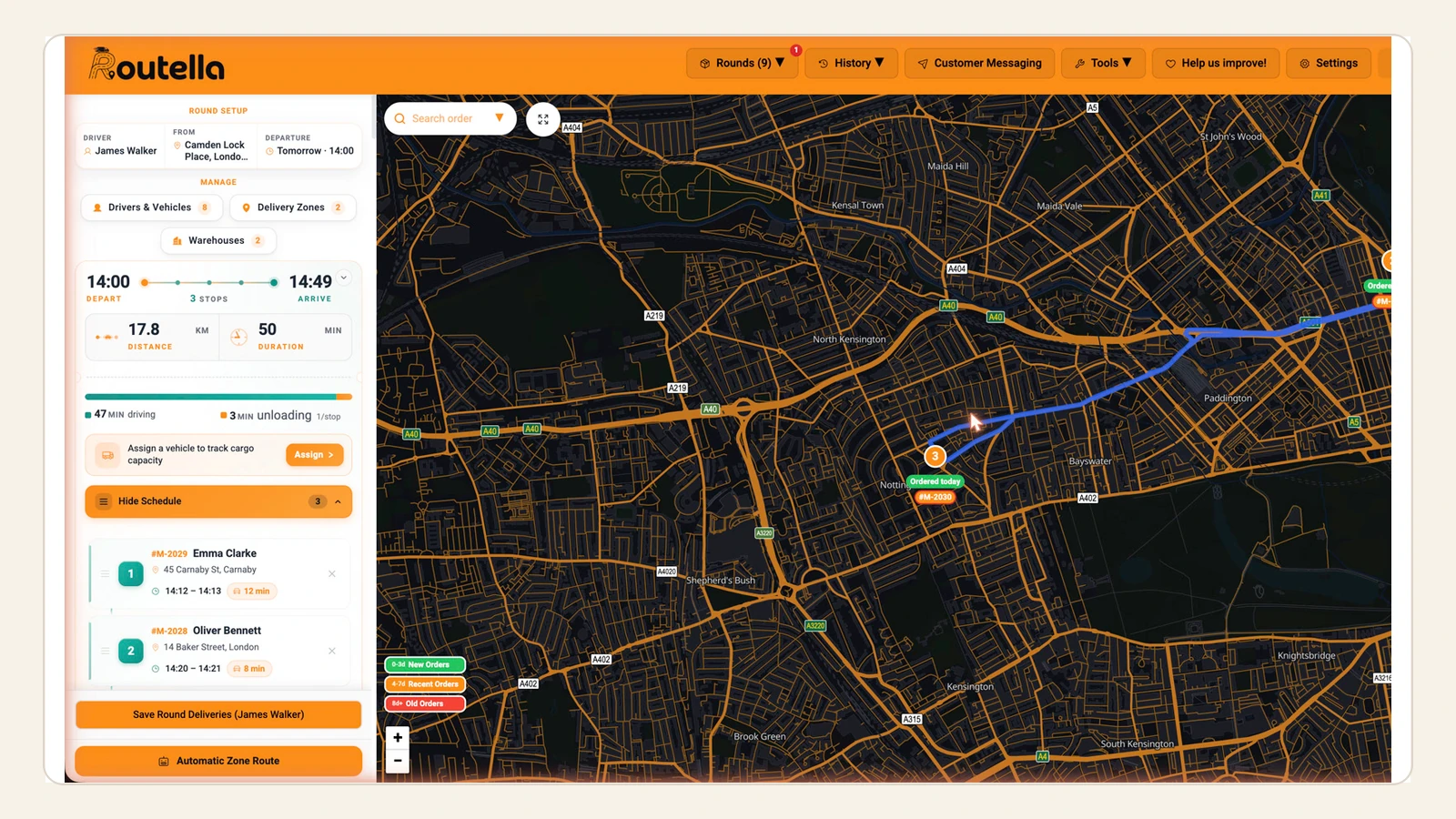
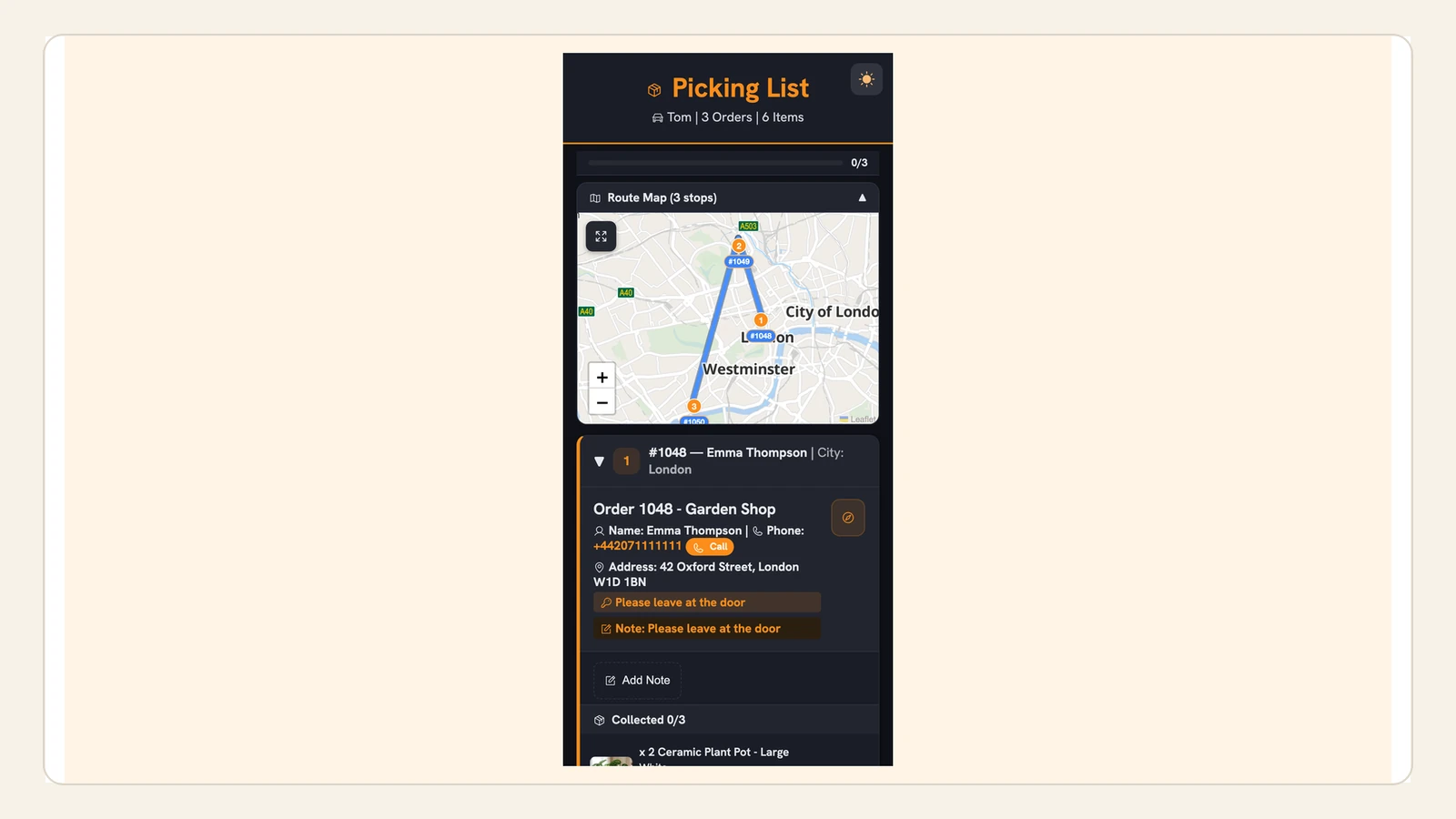
The fastest way to raise deliveries per day is to stop planning routes by hand and let software do the clustering, sequencing, and balancing for you — then measure whether each route is getting denser. That’s what a delivery platform is for. With Routella you draw delivery zones by drive time, let the free route optimizer sequence each driver’s stops, set realistic time windows, and balance work across the team — then protect first-attempt rate with live tracking, automatic notifications, and proof of delivery at every door. Drivers install nothing: they open a web link with their route, turn-by-turn navigation, and one-tap proof capture, which is the whole point of a delivery driver app that’s just a link.
Start by measuring your current deliveries per day and cost per drop, then plan a few real routes and compare. Routella has a genuinely usable free plan — 1 driver, 50 orders a month, no credit card — so you can run real deliveries before paying, then $29/month as you grow. See how Routella works, or dig into the economics behind the number in our cost per drop guide and route density guide.
Frequently asked questions
How many deliveries can one driver do in a day?
For a business running its own drivers on local routes, a working driver typically completes about 25–40 stops a day on dense urban routes, 15–25 on typical suburban routes, and 8–15 on spread-out rural routes. Large parcel carriers with tiny pre-sorted packages and drop-and-go handoffs can hit 80–120+, but that’s a different model — if each of your stops involves a real handoff, signature, or payment, plan around the local-delivery ranges, not the carrier number.
What determines how many deliveries a driver can make?
Two factors dominate: how far apart your stops are (the drive time between them) and how long each stop takes (service time — roughly 2–4 minutes for a residential drop, 5–8 for commercial). On top of that, what you deliver, how tight your time windows are, your first-attempt success rate, and driver experience all move the number. Density — keeping stops close together — is the single biggest lever, because it decides how much of the shift is spent driving versus delivering.
How do I calculate deliveries per day for my route?
Use: deliveries per day ≈ (available road hours × 60) ÷ (average service time per stop + average drive time per stop), with both times in minutes. For example, 7 productive road hours (420 minutes) with 4 minutes at each door and 6 minutes of driving between stops gives 420 ÷ 10 = 42 stops as a clean-day ceiling. Real days land lower because of failed attempts, depot trips, and traffic — which is exactly the gap that tighter zones and an optimized sequence reclaim.
How can a driver complete more deliveries per day?
Without driving faster or working longer: optimize the stop sequence (typically 10–20% more stops from better sequencing), cluster orders into tight delivery zones drawn by drive time, design time windows that don’t force backtracks, lift first-attempt success so no capacity is wasted on redeliveries, and cut avoidable service time by giving drivers the exact door and one-tap proof capture. If you run several drivers, balancing the load so no route runs half-empty adds capacity across the whole team.
How many stops per hour should a delivery driver do?
It depends on geography and what you deliver, but well-run suburban routes often target around 15–20 stops per hour of on-road time, while spread-out rural routes are more like 8–12. Treat those as a sanity check rather than a scoreboard — the figure that matters is your own stops per hour trending in the right direction on the same delivery area over time.
Does route optimization really increase deliveries per day?
Yes. Sequencing a multi-stop route by hand is slow and rarely optimal; optimization software finds a tight order in seconds and typically cuts total daily driving by 15–25% versus manual planning, which frees time to complete more stops. Operations commonly see 10–20% more deliveries per driver from sequencing alone, plus 30–60 minutes of driving saved per day. Routella includes a free route optimizer that builds each driver’s sequence and pairs it with zones, time windows, and driver balancing.
Run your own deliveries with Routella
Route optimization, a driver app, proof of delivery, and live customer tracking — in one platform. Free plan, no credit card.